Home
Weather London
WeatherRadar
RainfallRadar
TemperatureRadar
WindRadar
LightningRadar
Weather News
Editor's Pick
Discover the app
Weather widget
Contact us
Apps
Career
Home / Editor's Pick /

Winds over 46 mph: Defining a storm

Winds over 46 mph
Defining a storm

storm

Powerful storms all have different names, but they have one thing in common: they can cause immense damage. With winds over 46 mph, it is classified as a storm.

What is a storm?

A storm or depression is an area of low pressure that is associated with very low mean sea level pressure and high wind speeds. The average wind speed must be at least 46.9 mph, 75 km/h, or level 9 on the Beaufort scale.

In 1805, the English admiral Sir Francis Beaufort developed a scale for measuring wind force. It is divided into 12 levels that indicate how the wind affects areas.

At a Beaufort Scale of 8, the measured speed is between 39 - 46 mph. This is a gale-force wind, but not yet a storm. Large trees are moved at such wind speeds, branches can break and shutters can be opened.

A storm has a wind speed of around 47 mph or more, or Beaufort 9 according to the graphic above. From level 10 or around 55 mph, it is referred to as a severe storm, and from level 11 as a violent storm. At a wind force of 12 on the Beaufort scale, a storm has hurricane-force winds.

There can also be even higher wind speeds, which are predominantly recorded during typhoons, cyclones and hurricanes. Peak winds then can often reach more than 120 mph. Large-scale devastation is usually the result.

Did you know?

During Storm Ciarán in November 2023, winds gusted to 129 mph at Pointe du Raz, in Brittany, France.

If the wind only reaches gale force for a short period of time, for example a few seconds, this is referred to as a squall. Storms are also usually accompanied by heavy rain, or thunderstorms.

Depending on what a storm whirls up or what it is accompanied by, it can also be referred to as a snow, hail, sand or dust storm.

As tropical cyclones tend to have even higher wind speeds, other criteria are used to determine their strength. Hurricanes are assessed according to the Saffir-Simpson scale. It is subdivided according to wind speed and contains five levels.

Additionally, the Enhanced-Fujita scale is used to assign a tornado a 'rating' based on estimated wind speeds and related damage, divided into six levels.

Storm Lilian hits the UKread more
This might also interest you
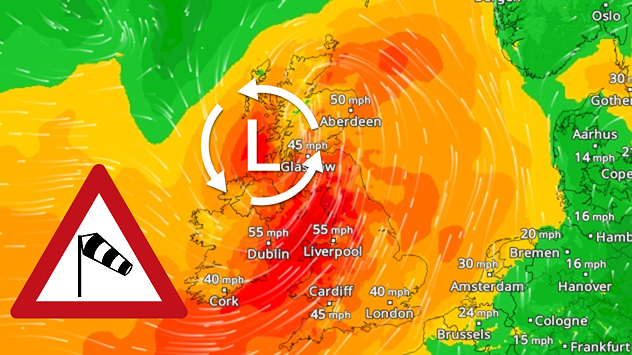
Wind map of the UK and Ireland showing a deep low-pressure system, Storm Dave, with red-orange zones and strong gusts up to 55 mph, plus a windsock warning icon indicating hazardous conditions.
Saturday, 4 April 2026

Severe overnight gales

Storm Dave makes impact
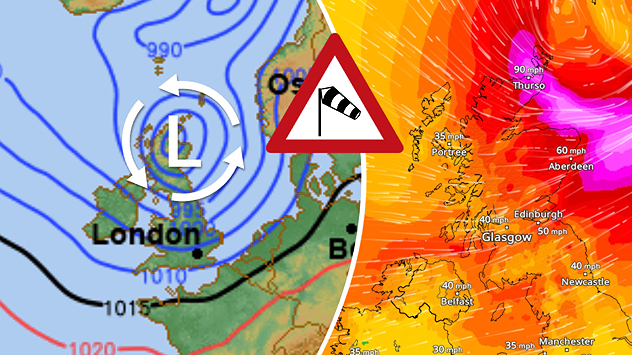
Split weather graphic showing a low-pressure system with tight isobars over the UK on the left and a wind map on the right with strong gusts up to 90 mph, plus a windsock warning icon.
Thursday, 2 April 2026

Gales and blizzards

Storm Dave disrupts Easter weekend
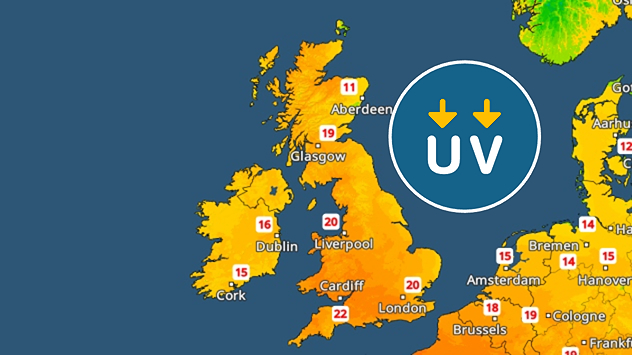
UK and Ireland map shaded in warm tones showing UV levels, with values up to 22 in southern England and lower values in Scotland, plus a circular UV icon.
Tuesday, 7 April 2026

Sunscreen season

UV levels rising with the warmth
All articles
Weather & Radar

Weather & Radar is also available on

Google Play StoreApp Store

Company

Contact us Privacy Policy Legal info Accessibility statement

Services

Uploader

Socials

facebooktwittertikToklinkList