Home
Weather London
WeatherRadar
RainfallRadar
TemperatureRadar
WindRadar
LightningRadar
Weather News
Editor's Pick
Discover the app
Weather widget
Contact us
Apps
Career
Home / Editor's Pick /

Types of rainfall: Frontal, orographic and convective

15:00
28 March 2023

Types of rainfall
Frontal, orographic and convective

rain-shutterstock

Rain is generally classified into three main types, based on how it is generated. Do you know them?

After a quiet start to the week it's all change with spells of rain expected to frequent from the west. Rainfall can be classified into frontal, orographic and convective, and today, we are experiencing frontal rain.

Frontal

Frontal rain occurs when colder air meets warmer air in a weather front. The warm air is then forced to rise over the cooler air leading to clouds and rain.

This type of rainfall happens everywhere in the UK and Ireland and tends to bring overcast skies and persistent rainfall.

Orographic

Orographic rainfall is most commonly found in hilly regions, and also explains why places in the west tend to be wetter. As air reaches land - or mountains - it is forced to rise.

This leads to the formation of clouds and then rainfall on the mountain, but often leaves the leeside (downwind) dry. When that happens it is called the "rain shadow effect".

Convective

For convective rain, or showers, the sun needs to shine on the ground and heat a layer of air close to Earth's surface. When the air close to the surface gets warm enough - and warmer than the air above it - it begins to rise up into the atmosphere.

The higher the air rises, the colder the atmosphere gets. At a certain level, the warm air will begin to cool and as a result the water vapour in the air condenses, forms a cloud and then we see rain.

On hot days, the warm air is able to move higher and faster into the atmosphere which sometimes can lead to the production of thunderstorms, which becomes more common as we head through the spring and summer months.

It is also the trickiest type of rain to forecast because showers can be so spatially and temporally variable.

Weather & Radar editorial team
More on the topic
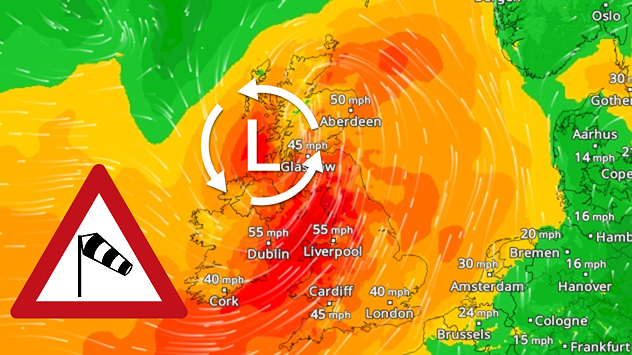
Wind map of the UK and Ireland showing a deep low-pressure system, Storm Dave, with red-orange zones and strong gusts up to 55 mph, plus a windsock warning icon indicating hazardous conditions.
Saturday, 4 April 2026

Severe overnight gales

Storm Dave makes impact
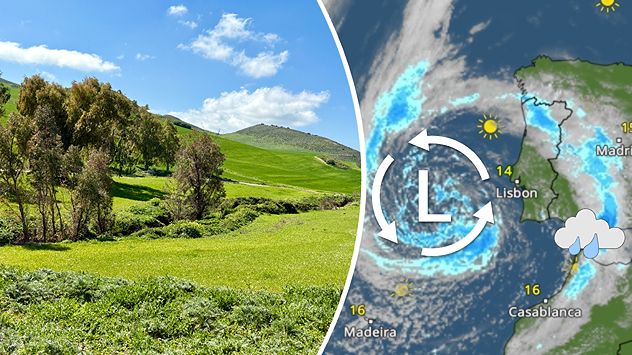
A green, rolling landscape after rain. Alongside it, a weather map showing a low-pressure system. Indications of further rainfall.
Wednesday, 8 April 2026

New low approaching

Morocco bursting to life after rain
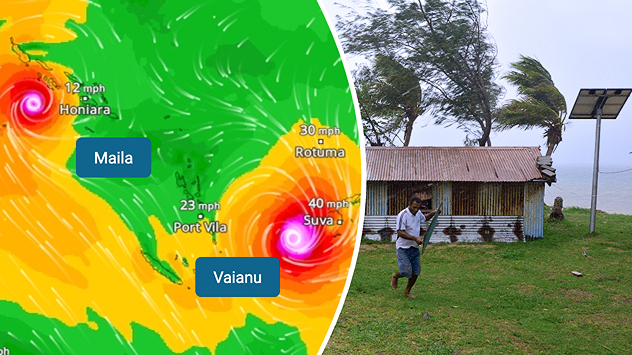
Two cyclones are currently threatening the South Sea islands off the coast of Australia.
Monday, 6 April 2026

Solomon Islands and Fiji

Cyclones threaten South Pacific islands
All weather news
This might also interest you
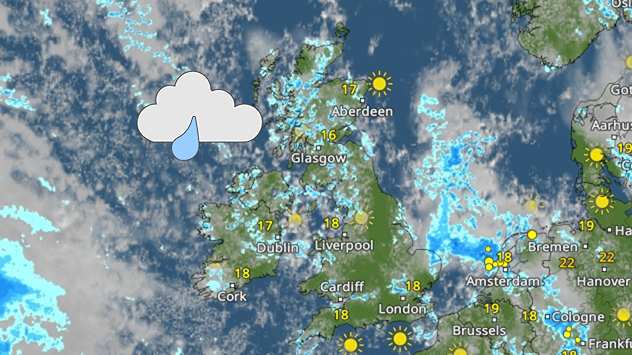
Weather map of the UK and Ireland showing scattered showers with cloudy patches across much of the region, especially around western and northern areas. Sunshine symbols appear over London, Cardiff, and parts of southern England, while temperatures range from 17°C to 18°C in most places. Areas of heavier rain are visible over the Atlantic to the west.
Friday, 29 August 2025

Breakfast brief

Unsettled conditions into the weekend
Weather graphic showing rain and wind fields over the Canary Islands and a central warning symbol.
Friday, 12 December 2025

Storm and rain

Turbulent weather in the Canary Islands
Split image showing aerial flooding in a town with muddy water covering roads on the left, and a rural road on the right blocked by heavy snowfall with vans stopped and a person walking in snow.
Tuesday, 27 January 2026

Storm Chandra

Flooding, gales, and heavy snow
All articles
Weather & Radar

Weather & Radar is also available on

Google Play StoreApp Store

Company

Contact us Privacy Policy Legal info Accessibility statement

Services

Uploader

Socials

facebooktwittertikToklinkList