Home
Weather London
WeatherRadar
RainfallRadar
TemperatureRadar
WindRadar
LightningRadar
Weather News
Editor's Pick
Discover the app
Weather widget
Contact us
Apps
Career
Home / Editor's Pick /

Twilight skies: What causes the explosion of colours?

16:00
28 January 2023

Twilight skies
What causes the explosion of colours?

twilight

As soon as the sun goes down, sunlight is by no means over. Twilight offers an explosion of colours in the sky for us to marvel at.

Twilight is the transitional period between day and night. In the evening it is called dusk, in the morning, dawn. Air molecules, aerosols and cloud droplets trigger the blaze of colour in the sky that often accompanies twilight.

How is twilight formed?

Tiny particles in the atmosphere are responsible for the colours lighting up the sky. When the sun is only slightly above the horizon, light takes a longer path through the atmosphere, than when the sun is higher up.

The influence of air molecules and aerosols, such as dust, increases the closer the sun is to the horizon. As shorter wavelengths (blue tones) are scattered more strongly, the sky turns a yellowish-red.

After sunset, the colours become even more intense because the low angle of the sun also illuminates the clouds.

Long after sunset, when the first stars twinkle, the sky turns deep blue. Although all the sun's rays have travelled a long way through the atmosphere, the blue colour components dominate once again.

This blue is a result of the stratospheric ozone layer at an altitude of 20 to 30 kilometres. Here, ozone molecules absorb the orange part of the light.

The selective absorption shifts the colours to the shorter wavelengths, i.e. to blue. When the sun is low, the ozone layer acts like a blue colour filter and we can see it with the naked eye.

Keep an eye out for our tips coming soon on how to photograph at twilight!

Weather & Radar editorial team
More on the topic
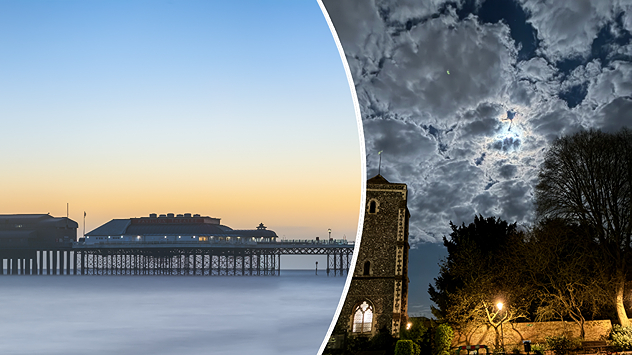
Split image with Cromer Pier at sunset on the left in soft orange-blue tones and a moonlit Canterbury church with dramatic clouds on the right, lit by a streetlamp.
Sunday, 5 April 2026

Your weather - Your shots

Spring captured after the clock change
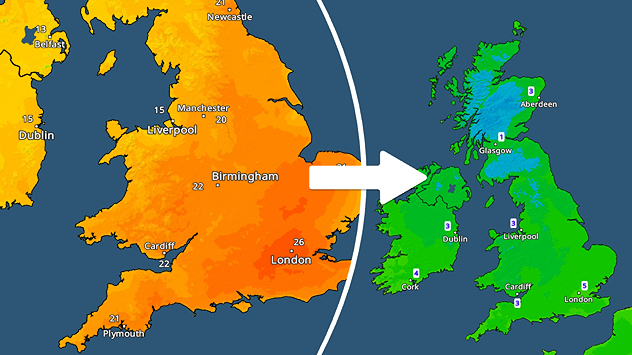
Split UK map showing warm orange temperatures up to 26 degrees on the left transitioning to cooler green tones around 3 to 5 degrees on the right, with an arrow indicating change.
Wednesday, 8 April 2026

A quick shift

High of the year to a cooler spell
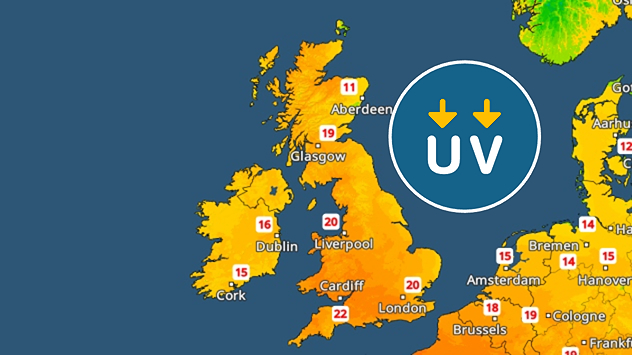
UK and Ireland map shaded in warm tones showing UV levels, with values up to 22 in southern England and lower values in Scotland, plus a circular UV icon.
Tuesday, 7 April 2026

Sunscreen season

UV levels rising with the warmth
All weather news
This might also interest you
Illustration of white and yellow fireworks on a blue background.
Wednesday, 31 December 2025

Hello 2026

Happy New Year
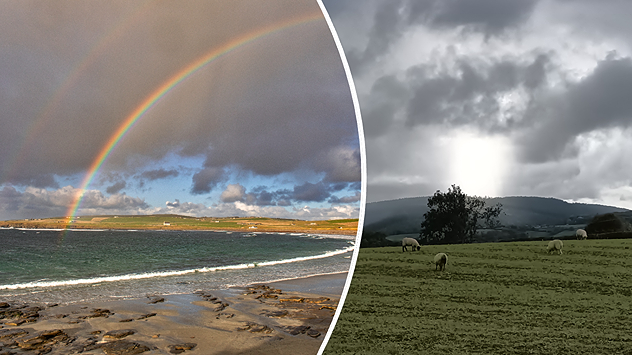
plit image showing a double rainbow over a rocky shoreline on the left and sheep grazing in a green field under stormy clouds on the right.
Sunday, 2 November 2025

Your weather - Your shots

Mixed conditions on an unsettled week
Outline of Santa Claus with a yellow and white hat, "Ho-Ho-Ho" next to the outline above a Christmas tree.
Thursday, 25 December 2025

Merry Christmas!

Wishes from Weather & Radar
All articles
Weather & Radar

Weather & Radar is also available on

Google Play StoreApp Store

Company

Contact us Privacy Policy Legal info Accessibility statement

Services

Uploader

Socials

facebooktwittertikToklinkList