Home
Weather London
WeatherRadar
RainfallRadar
TemperatureRadar
WindRadar
LightningRadar
Weather News
Editor's Pick
Discover the app
Weather widget
Contact us
Apps
Career
Home / Editor's Pick /

The four different types of frost

15:00
22 January 2023

Hoar, air, grass & ground
The four different types of frost

frosty-shutterstock

As the winter season gets well and truly underway, temperatures are regularly falling below freezing overnight, leaving frosty mornings behind.

Hearing a risk of frost in a forecast is quite common in the colder months, but did you know there are different types of frost? These are hoar, air, grass and ground.

Ground and grass frosts are most common between autumn and spring, while air and hoar frosts are most common during the winter season.

An air frost occurs when the temperature of the air falls to or below 0C although it is usually defined as a temperature below 0C at a height of one metre above the ground. When you hear on the television that there will be a frost, they are most likely referring to an air frost.

A grass frost refers to frost on grass or vegetation. This is because vegetation is more sensitive to temperature changes so the frost can appear while roads or windows might remain frost-free.

A ground frost refers to ice on the ground, objects or trees that have a temperature below the freezing point of water. Sometimes you can get a ground frost without an air frost. This happens when the ground cools faster than the air.

Finally, there is hoar frost. This is a fine and needle-like frost that occurs when water vapour in damp air freezes directly and quickly on surfaces. This is what gives it its white appearance.

In general, frost forms when a surface cools below a dew point. This is where an air parcel gets cold enough to turn into water vapour. If temperatures are cool enough, the water vapour freezes on objects to create the frost.

Learn more about how frost forms by watching our Weather Explained video below:

Watch our explainer video to find out how a physical frost forms.
Weather & Radar editorial team
More on the topic
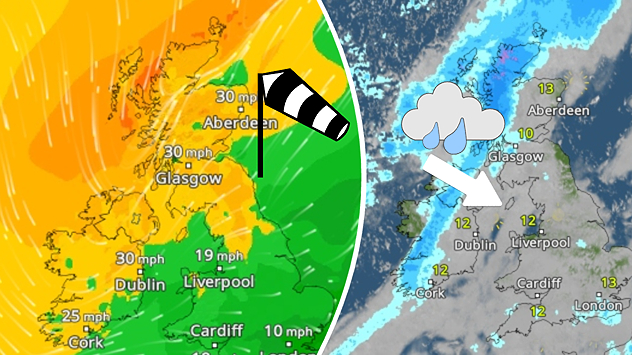
Split weather graphic showing breezy conditions across the UK and Ireland on the left with winds around 25–30 mph, and a rain band moving east across Ireland into Britain on the right.
Tuesday, 31 March 2026

Unsettled midweek

Wet & windy Wednesday for some
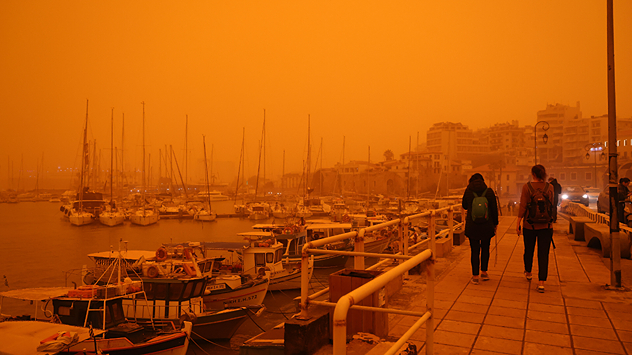
A harbour in Crete with a reddish-brown, overcast sky
Friday, 3 April 2026

Blood red skies

Dust storm in Crete
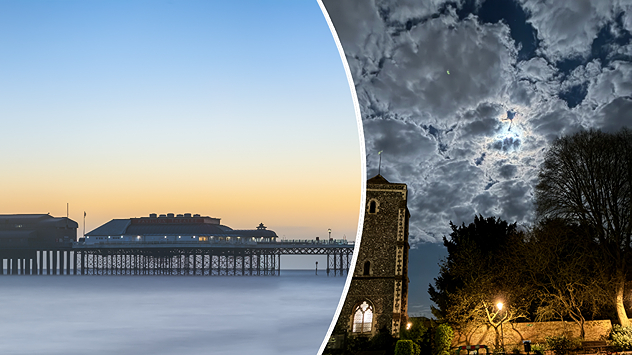
Split image with Cromer Pier at sunset on the left in soft orange-blue tones and a moonlit Canterbury church with dramatic clouds on the right, lit by a streetlamp.
Sunday, 5 April 2026

Your weather - Your shots

Spring captured after the clock change
All weather news
This might also interest you
Illustration of white and yellow fireworks on a blue background.
Wednesday, 31 December 2025

Hello 2026

Happy New Year
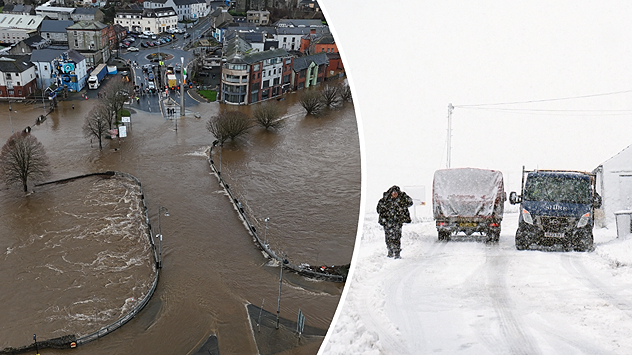
Split image showing aerial flooding in a town with muddy water covering roads on the left, and a rural road on the right blocked by heavy snowfall with vans stopped and a person walking in snow.
Tuesday, 27 January 2026

Storm Chandra

Flooding, gales, and heavy snow
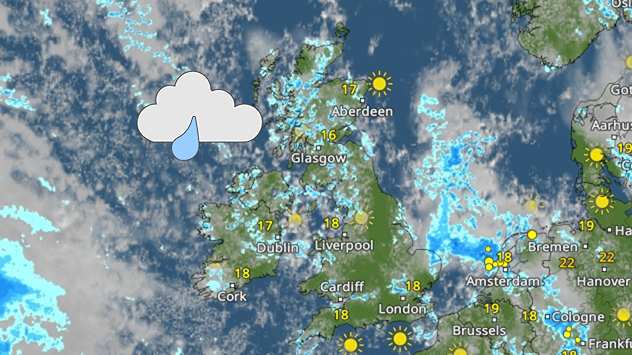
Weather map of the UK and Ireland showing scattered showers with cloudy patches across much of the region, especially around western and northern areas. Sunshine symbols appear over London, Cardiff, and parts of southern England, while temperatures range from 17°C to 18°C in most places. Areas of heavier rain are visible over the Atlantic to the west.
Friday, 29 August 2025

Breakfast brief

Unsettled conditions into the weekend
All articles
Weather & Radar

Weather & Radar is also available on

Google Play StoreApp Store

Company

Contact us Privacy Policy Legal info Accessibility statement

Services

Uploader

Socials

facebooktwittertikToklinkList