Home
Weather London
WeatherRadar
RainfallRadar
TemperatureRadar
WindRadar
LightningRadar
Weather News
Editor's Pick
Discover the app
Weather widget
Contact us
Apps
Career
Home / Editor's Pick /

The four different types of frost

15:00
22 January 2023

Hoar, air, grass & ground
The four different types of frost

frosty-shutterstock

As the winter season gets well and truly underway, temperatures are regularly falling below freezing overnight, leaving frosty mornings behind.

Hearing a risk of frost in a forecast is quite common in the colder months, but did you know there are different types of frost? These are hoar, air, grass and ground.

Ground and grass frosts are most common between autumn and spring, while air and hoar frosts are most common during the winter season.

An air frost occurs when the temperature of the air falls to or below 0C although it is usually defined as a temperature below 0C at a height of one metre above the ground. When you hear on the television that there will be a frost, they are most likely referring to an air frost.

A grass frost refers to frost on grass or vegetation. This is because vegetation is more sensitive to temperature changes so the frost can appear while roads or windows might remain frost-free.

A ground frost refers to ice on the ground, objects or trees that have a temperature below the freezing point of water. Sometimes you can get a ground frost without an air frost. This happens when the ground cools faster than the air.

Finally, there is hoar frost. This is a fine and needle-like frost that occurs when water vapour in damp air freezes directly and quickly on surfaces. This is what gives it its white appearance.

In general, frost forms when a surface cools below a dew point. This is where an air parcel gets cold enough to turn into water vapour. If temperatures are cool enough, the water vapour freezes on objects to create the frost.

Learn more about how frost forms by watching our Weather Explained video below:

Watch our explainer video to find out how a physical frost forms.
Weather & Radar editorial team
More on the topic
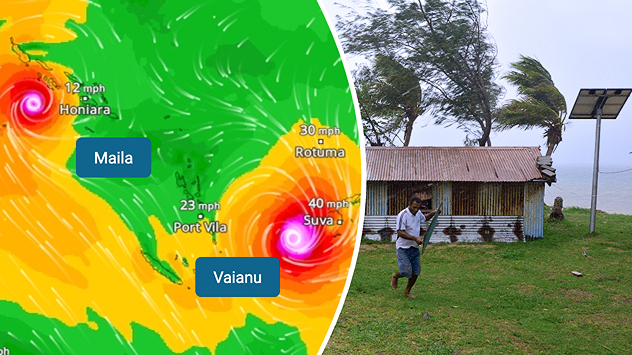
Two cyclones are currently threatening the South Sea islands off the coast of Australia.
Monday, 6 April 2026

Solomon Islands and Fiji

Cyclones threaten South Pacific islands
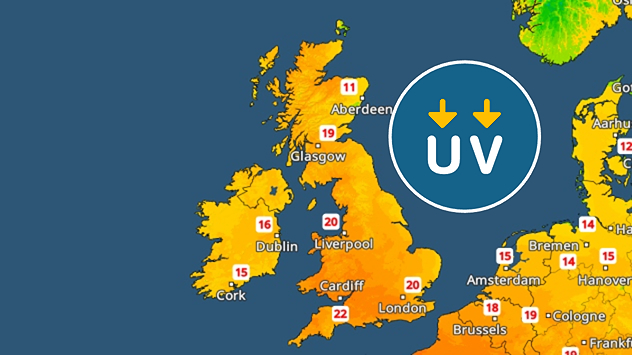
UK and Ireland map shaded in warm tones showing UV levels, with values up to 22 in southern England and lower values in Scotland, plus a circular UV icon.
Tuesday, 7 April 2026

Sunscreen season

UV levels rising with the warmth
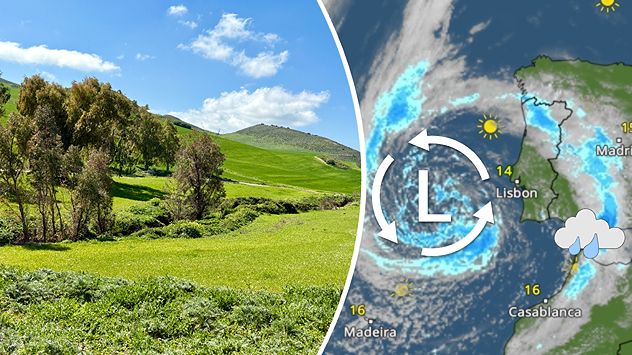
A green, rolling landscape after rain. Alongside it, a weather map showing a low-pressure system. Indications of further rainfall.
Wednesday, 8 April 2026

New low approaching

Morocco bursting to life after rain
All weather news
This might also interest you
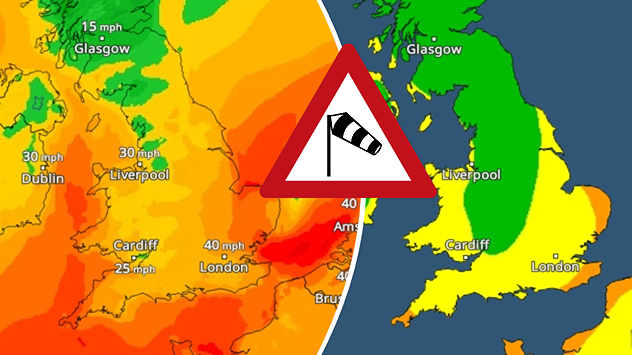
Split weather map showing UK wind speeds in orange-red shades up to 40 mph on the left and warning levels in green-yellow on the right, with a central wind warning sign.
Wednesday, 22 October 2025

Warnings active

Storm Benjamin impacts the UK
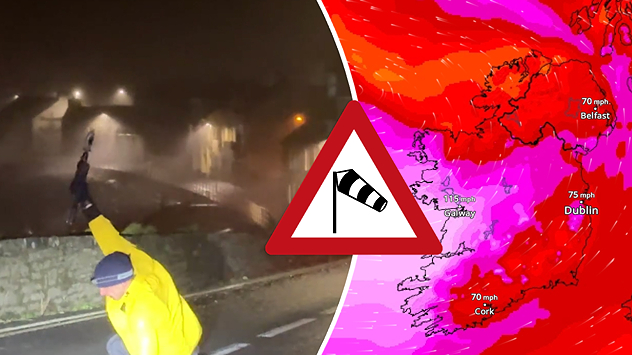
Split image showing a person in a yellow jacket struggling against strong winds and heavy rain on a street at night on the left, and an Irish wind forecast map on the right with red and purple shading, gusts up to 75 mph, and a wind warning icon, divided by a curved white line.
Saturday, 24 January 2026

On this day...

Historic Storm Éowyn arrives
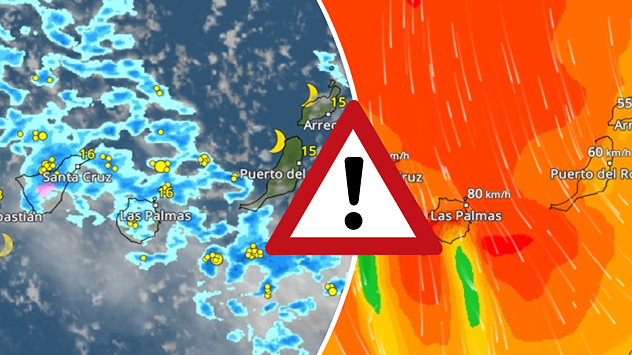
Weather graphic showing rain and wind fields over the Canary Islands and a central warning symbol.
Friday, 12 December 2025

Storm and rain

Turbulent weather in the Canary Islands
All articles
Weather & Radar

Weather & Radar is also available on

Google Play StoreApp Store

Company

Contact us Privacy Policy Legal info Accessibility statement

Services

Uploader

Socials

facebooktwittertikToklinkList