Home
Weather London
WeatherRadar
RainfallRadar
TemperatureRadar
WindRadar
LightningRadar
Weather News
Editor's Pick
Discover the app
Weather widget
Contact us
Apps
Career
    Home / Editor's Pick /

    Spotted in the UK: Incredible display of aurora

10:01
28 September 2022

Spotted in the UK
Incredible display of aurora

Privacy Policy

On September 26th, parts of Canada, North America, Scandinavia and even the UK were blessed by an un expected northern lights display.

People were caught by surprise on Monday night when they went outdoors to photograph Jupiter, but instead captured a jaw-dropping display of aurora overhead.

NOAA's Space Center predicted visibility as far south as 50 degrees N, with people capturing the aurora as far south as Bulmer in North Yorkshire, at about 54 degrees N.

This was due to a sudden spike in solar activity, the result of a CME (coronal mass ejection). It consequently disturbed our magnetic field, producing the brilliant display of aurora.

Aurora can be difficult to spot with the naked eye, but beautifully photographed with a few handy tips:

  • Long exposure is critical; often around 12-20 seconds, though some may need nearer to 30 seconds
  • Use a tripod to keep your camera still
  • Avoid being around external light sources
  • A fast aperture of minimum f4, but ideally f2.8
  • The higher the ISO, the more light you capture, but the grainier the shot
  • Clear skies are needed - check our WeatherRadar for cloud cover

The spectacular colours can be attributed to the gases present in the atmosphere. Green is associated with oxygen, whilst purple, blue, or pink are typical with nitrogen.

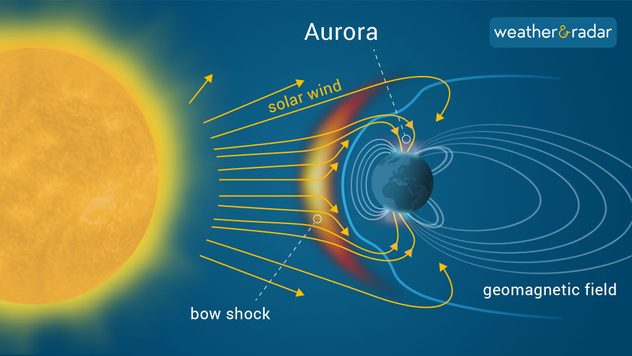
Auroras are caused when the sun ejects significant amounts of particles towards Earth, during periods of heightened solar activity.

This material then interacts with the Earth's magnetic fields and the gases in our atmosphere, producing the display.

aurora infographic

If you've ever managed to capture this breathtaking phenomenon, send in your photos to our uploader here.

Weather & Radar editorial team
More on the topic
Fourth heatwave of the year. Peaking Wednesday. . . Tuesday, 28 July 2026
Temperature map of England and Wales on Wednesday 29.07 showing widespread hot conditions, with temperatures reaching 33°C near Cambridge, 32°C around London, Norwich, and Southend-on-Sea, and a large heat warning symbol highlighting elevated heat risk.
Tuesday, 28 July 2026

Peaking Wednesday

Fourth heatwave of the year
Clouds return to capture the scene. Your weather - Your shots. . . Sunday, 26 July 2026
Waxing crescent Moon above vivid pink and magenta sunset clouds, with silhouetted trees along the horizon beneath a deepening blue twilight sky.
Sunday, 26 July 2026

Your weather - Your shots

Clouds return to capture the scene
Heavier rainfall over the week for some. Ireland & Scotland. . . Tuesday, 28 July 2026
Split image showing a Europe rainfall accumulation forecast map on the left with the highest totals across the UK, Ireland, and Scandinavia, and a satellite weather map on the right with a broad band of rain stretching across Ireland, Scotland, and northern Britain, highlighted by a rain cloud icon.
Tuesday, 28 July 2026

Ireland & Scotland

Heavier rainfall over the week for some
All weather news
This might also interest you
A frozen start to the weekend. Icy conditions. . . Friday, 13 February 2026
UK temperature map dated 14.02 showing widespread subzero values in blue shading, with readings such as −4 in Glasgow, −3 in Dublin, and −2 in London, alongside a blue thermometer icon.
Friday, 13 February 2026

Icy conditions

A frozen start to the weekend
Bright and warm conditions take hold. Spring-like outlook. . . Thursday, 23 April 2026
Split UK map showing warm temperatures up to 21 degrees in orange on the left and clear sunny conditions with temperatures from 12 to 18 degrees on the right, with sun icons across the country.
Thursday, 23 April 2026

Spring-like outlook

Bright and warm conditions take hold
Super Typhoon Bavi threatens Taiwan. Up to 1,000 mm of rain. . . Wednesday, 8 July 2026
The image shows an intense tropical cyclone over the western Pacific, east of Taiwan and the Philippines. The centre of the system is depicted as a light purple and white vortex with a clearly visible eye, surrounded by a ring of red and orange areas indicating the strongest wind speeds. A white arrow marks the typhoon’s predicted track towards the north-west, in the direction of Taiwan. To the west of the storm lie the Philippines, with the cities of Manila and Cebu; to the north of these lies Taiwan, with Taipei. Further west, the Chinese coast, including Hong Kong, and parts of Vietnam can be seen. The coloured wind map shows predominantly green areas outside the storm’s core, indicating significantly weaker winds. White streamlines illustrate the typhoon’s anti-clockwise circulation in the Northern Hemisphere. The highest wind speeds are concentrated around the eye of the cyclone.
Wednesday, 8 July 2026

Up to 1,000 mm of rain

Super Typhoon Bavi threatens Taiwan
All articles
Weather & Radar

Weather & Radar is also available on

Google Play StoreApp Store

Company

Contact us Privacy Policy Legal info Accessibility statement

Services

Uploader

Socials

facebooktwittertikToklinkList