Home
Weather London
WeatherRadar
RainfallRadar
TemperatureRadar
WindRadar
LightningRadar
Weather News
Editor's Pick
Discover the app
Weather widget
Contact us
Apps
Career
Home / Editor's Pick /

Solar maximum in 2024: Sun activity rising faster than expected

15:00
23 July 2023

Solar maximum in 2024
Sun activity rising faster than expected

Solar activityAn active area of the sun during the previous solar cycle in 2018. - © NASA/GSFC/Solar Dynamics Observatory

Solar activity is becoming increasingly volatile as the sun approaches its solar maximum earlier than expected.

The sun is in a constant cycle of activity, each solar cycle lasts for around 11 years, with the most volatile stage known as the solar maximum.

Previously, this was expected to arrive in mid-2025. A rise in activity in recent weeks has seen astronomers bring this forecast forward to mid- to late-2024.

When the solar maximum occurs the sun’s magnetic field flips, there is an increase in the number of sunspots, areas where the sun’s magnetic field is much stronger, and solar flares.

If these flares are fired in the direction of Earth, they interact with the atmosphere on arrival and create vibrant auroras.

Earlier this week, two coronal mass ejections (CME) were observed to be ejected by sunspots in our planet’s direction.

The first was launched July 14 and was followed a day later by a larger, faster travelling ejection. This resulted in a rare cannibal CME where the first was consumed by the second.

Flare or CME?

A solar flare is a burst of electromagnetic radiation which can reach Earth in eight minutes. CMEs are an expulsion of plasma from the sun's atmosphere and can take days to arrive.

Larger solar storms also see auroras spread to more southern latitudes. The cannibal CME this week means that auroras were visible over Scotland and areas of northern England.

Events such as these can interrupt radio signals on Earth, and satellites are also at risk. In February 2022, a solar storm destroyed 40 Starlink satellites launched by Elon Musk’s SpaceX.

Ryan Hathaway
More on the topic
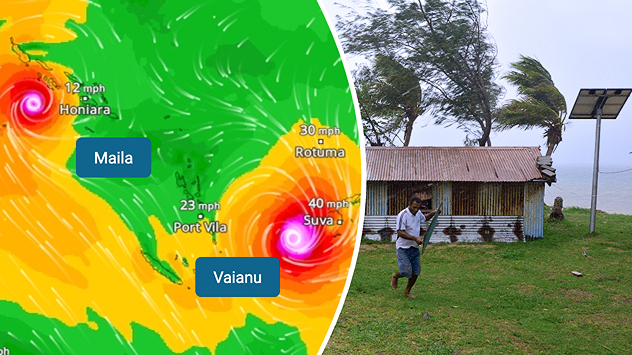
Two cyclones are currently threatening the South Sea islands off the coast of Australia.
Monday, 6 April 2026

Solomon Islands and Fiji

Cyclones threaten South Pacific islands
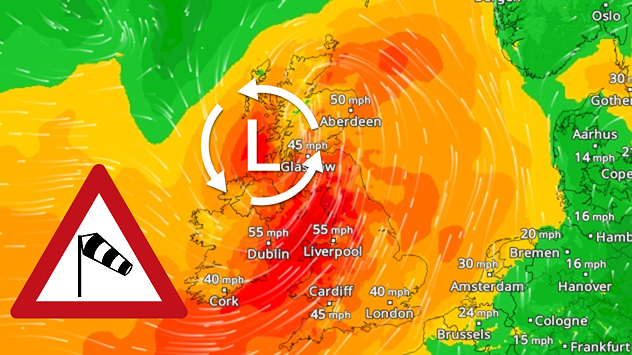
Wind map of the UK and Ireland showing a deep low-pressure system, Storm Dave, with red-orange zones and strong gusts up to 55 mph, plus a windsock warning icon indicating hazardous conditions.
Saturday, 4 April 2026

Severe overnight gales

Storm Dave makes impact
Split image with Cromer Pier at sunset on the left in soft orange-blue tones and a moonlit Canterbury church with dramatic clouds on the right, lit by a streetlamp.
Sunday, 5 April 2026

Your weather - Your shots

Spring captured after the clock change
All weather news
This might also interest you
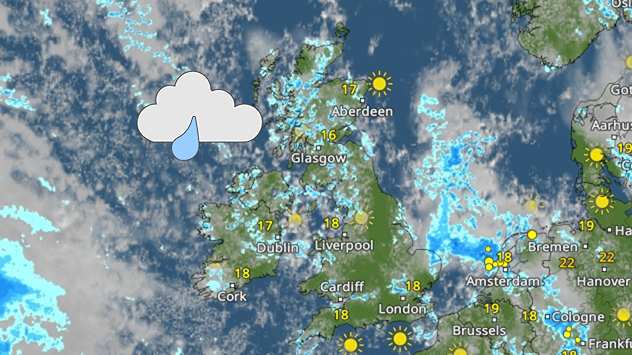
Weather map of the UK and Ireland showing scattered showers with cloudy patches across much of the region, especially around western and northern areas. Sunshine symbols appear over London, Cardiff, and parts of southern England, while temperatures range from 17°C to 18°C in most places. Areas of heavier rain are visible over the Atlantic to the west.
Friday, 29 August 2025

Breakfast brief

Unsettled conditions into the weekend
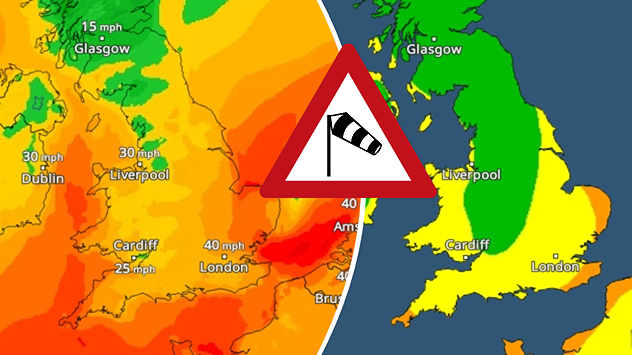
Split weather map showing UK wind speeds in orange-red shades up to 40 mph on the left and warning levels in green-yellow on the right, with a central wind warning sign.
Wednesday, 22 October 2025

Warnings active

Storm Benjamin impacts the UK
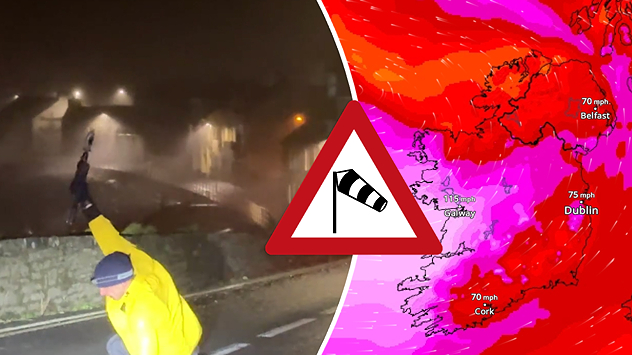
Split image showing a person in a yellow jacket struggling against strong winds and heavy rain on a street at night on the left, and an Irish wind forecast map on the right with red and purple shading, gusts up to 75 mph, and a wind warning icon, divided by a curved white line.
Saturday, 24 January 2026

On this day...

Historic Storm Éowyn arrives
All articles
Weather & Radar

Weather & Radar is also available on

Google Play StoreApp Store

Company

Contact us Privacy Policy Legal info Accessibility statement

Services

Uploader

Socials

facebooktwittertikToklinkList