Home
Weather London
WeatherRadar
RainfallRadar
TemperatureRadar
WindRadar
LightningRadar
Weather News
Editor's Pick
Discover the app
Weather widget
Contact us
Apps
Career
    Home / Editor's Pick /

    Snow cannons at work: Artificial snow for winter sports

Snow cannons at work
Artificial snow for winter sports

Snow cannon
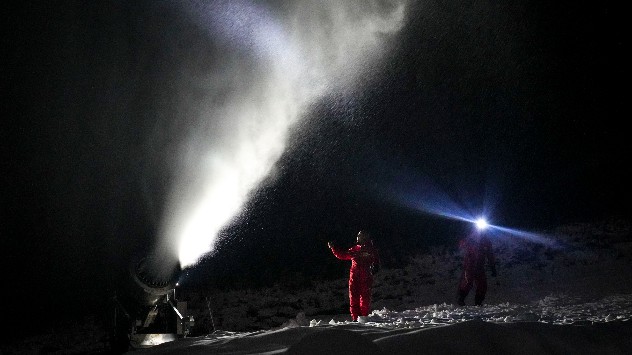
Snow cannon at work at the Changbai Mountain Ski Resort. - © picture alliance

Snow cannons are widely used around the world where natural snow is insufficient, for the likes of the Beijing Olympics and Paralympics back in 2022.

China saw its warmest year on record in 2022 and as a result experienced drought conditions. Despite some natural snow at high altitudes, widespread use of artificial snow was needed for the winter Olympic sports.

High-pressure conditions, with clear and cold nights, are ideal for the production of artificial snow which is created by firing small water droplets into the air where they freeze and fall to the ground.

Additional nucleators are often added to the water, which helps ice crystals form faster.

Artificial snow lasts longer than the real thing but provides a heavier feel for skiers due to the higher water content.

The use of snow cannons is increasingly popular, with more than 60% of the world’s ski resorts now using them to supplement a decreasing amount of natural snowfall.

Using artificial snow is nothing new for the Winter Olympics, however. The first time it was used was in 1980 in Lake Placid, New York, USA, when a dry winter produced less snow than normal.

In addition to the ongoing drought, climate change has influenced the need for artificial snow on the slopes.

To make and provide artificial snow, officials used water from nearby reservoirs known as Foyukou and Baihepu.

Snowfarming in Switzerlandread more
Weather & Radar editorial team
This might also interest you
Fourth heatwave of the year. Peaking Wednesday. . . Tuesday, 28 July 2026
Temperature map of England and Wales on Wednesday 29.07 showing widespread hot conditions, with temperatures reaching 33°C near Cambridge, 32°C around London, Norwich, and Southend-on-Sea, and a large heat warning symbol highlighting elevated heat risk.
Tuesday, 28 July 2026

Peaking Wednesday

Fourth heatwave of the year
UV levels peak with the heat today. Latest heatwave. . . Wednesday, 29 July 2026
Split graphic showing a temperature map of England and eastern Ireland with temperatures reaching 33°C near London, 32°C in Norwich, and 29°C around Birmingham on the left, alongside a person applying sunscreen with a UV icon on the right.
Wednesday, 29 July 2026

Latest heatwave

UV levels peak with the heat today
Floods and landslides in parts of Asia. An unusual monsoon. . . Wednesday, 29 July 2026
Split image: On the left, flooded villages and fields can be seen in a vast landscape. On the right, a weather map of India shows heavy rainfall, along with a warning sign featuring a car in floodwater.
Wednesday, 29 July 2026

An unusual monsoon

Floods and landslides in parts of Asia
All articles
Weather & Radar

Weather & Radar is also available on

Google Play StoreApp Store

Company

Contact us Privacy Policy Legal info Accessibility statement

Services

Uploader

Socials

facebooktwittertikToklinkList