Home
Weather London
WeatherRadar
RainfallRadar
TemperatureRadar
WindRadar
LightningRadar
Weather News
Editor's Pick
Discover the app
Weather widget
Contact us
Apps
Career
Home / Editor's Pick /

Qatar World Cup 2022: How climate affects football

08:00
10 December 2022

Qatar World Cup 2022
How climate affects football

qatar

The first FIFA World Cup was played in 1930. Since then, global temperatures have risen sharply. How has the heat affected this year’s World Cup in Qatar?

The rate of warming, globally, since 1981 has been 0.18C per decade. For Qatar, the warming has also been sharply increasing since late last century.

The mean temperature in 2001 was 28.22C. In 2021, the mean temperature was 29.42C. Temperatures have been increasing dramatically in these 20 years, in comparison to the previous 20 years, where the mean temperature was 27.54C in 1981.

The previous century’s rate was 0.68C, while in the last 20 years within this century, the rate of temperature change has almost doubled to 1.22C.

This heat puts everyone at risk. The World Cup simply could not have been played in the summertime in Qatar, which is when this championship is usually played.

Average afternoon temperatures in Qatar in the summer range between35 and 36.5C. These months are also usually the ones with the least precipitation, so there is no relief. Consequently, the World Cup was moved to the winter this year.

Even before it started, many workers, like construction workers, suffered from extreme heat, who had been working tirelessly to build stadiums and buildings in preparation for this worldly event.

The high temperatures are also worsened by high humidity levels. Moisture from the Persian Gulf makes this region a place with high humidity that can be deadly. The death rate of foreign workers is known to have increased in Qatar in the last few years.

It is also estimated that there are over a million visitors in Qatar, with many of these people, including players, not used to this heat, especially in December. Currently, this area is experiencing some of the most extreme heat on the planet.

What’s being done?

Some say that the World Cup should not have been moved, but if the Cup had been held in summer, players, fans, and workers would have experienced between 50% and 70% more hours of intense heat, which would have increased fatalities significantly.

Olympic committees have been putting in new rules to protect players from the heat. In 2014 FIFA introduced water breaks during a match at minute-30 and 75 when there is extreme heat.

Host nations now need to invest more money in building resilient infrastructure, as well as air-conditioned stadiums to protect workers and visitors.

Weather & Radar editorial team
More on the topic
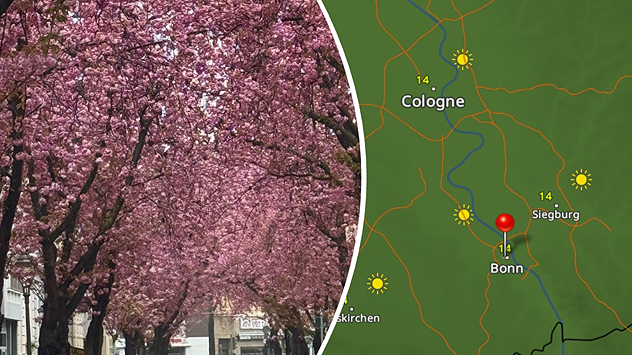
Pink-blossoming cherry trees lining a street next to the weather radar, with sunshine and temperatures around 19 degrees near Bonn.
Tuesday, 7 April 2026

Cherry blossoms in Bonn

Spring bloom on show
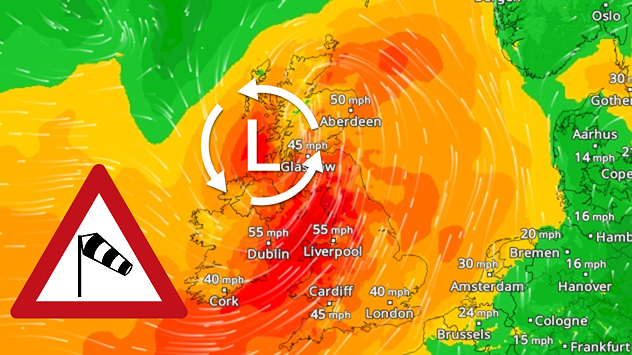
Wind map of the UK and Ireland showing a deep low-pressure system, Storm Dave, with red-orange zones and strong gusts up to 55 mph, plus a windsock warning icon indicating hazardous conditions.
Saturday, 4 April 2026

Severe overnight gales

Storm Dave makes impact
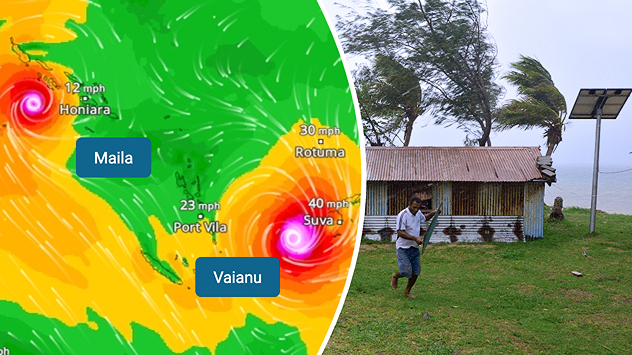
Two cyclones are currently threatening the South Sea islands off the coast of Australia.
Monday, 6 April 2026

Solomon Islands and Fiji

Cyclones threaten South Pacific islands
All weather news
This might also interest you
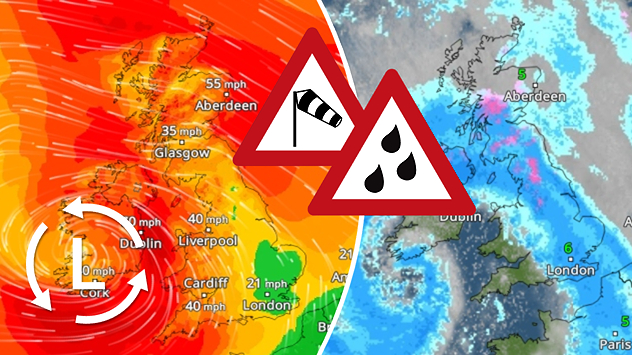
Split image showing strong winds over the UK on a forecast map and widespread rain and snow on a weather radar map.
Tuesday, 27 January 2026

Severe gales & heavy rain

Storm Chandra makes impact
Weather map of the UK and Ireland showing scattered showers with cloudy patches across much of the region, especially around western and northern areas. Sunshine symbols appear over London, Cardiff, and parts of southern England, while temperatures range from 17°C to 18°C in most places. Areas of heavier rain are visible over the Atlantic to the west.
Friday, 29 August 2025

Breakfast brief

Unsettled conditions into the weekend
UK temperature map dated 14.02 showing widespread subzero values in blue shading, with readings such as −4 in Glasgow, −3 in Dublin, and −2 in London, alongside a blue thermometer icon.
Friday, 13 February 2026

Icy conditions

A frozen start to the weekend
All articles
Weather & Radar

Weather & Radar is also available on

Google Play StoreApp Store

Company

Contact us Privacy Policy Legal info Accessibility statement

Services

Uploader

Socials

facebooktwittertikToklinkList