Home
Weather London
WeatherRadar
RainfallRadar
TemperatureRadar
WindRadar
LightningRadar
Weather News
Editor's Pick
Discover the app
Weather widget
Contact us
Apps
Career
Home / Editor's Pick /

Ötzi the Stone Age Man : New knowledge about the glacier mummy

09:30
15 November 2022

Ötzi the Stone Age Man
New knowledge about the glacier mummy

This is what the glacier mummy looked like when it was found in 1991.This is what the glacier mummy looked like when it was found in 1991. - © picture alliance

New knowledge about the glacier mummy Ötzi: The Stone Age man from the Alps probably died more than 5000 years ago, at a different time of year than previously thought.

In 1991, a sensational discovery was made in the Alps: on the Tisenjoch in the Ötztal Alps near the Italian-Austrian border, the oldest natural mummy of a Stone Age man was found. Since then, archaeologists have been trying to reconstruct Ötzi's movements before his death, and what also happened in the time after his death.

Until now, many experts have assumed that Ötzi fled into the mountains with damaged equipment after some violent confrontation, after which he died in a canyon in Tisenjoch in the autumn. The theory was that he was then quickly buried in snow and ice.

It wasn't until about 5,300 years later that the glaciers melted and released him, following unprecedented melting.

Ötzi apparently did not die in the autumn

A new study suggests it may have happened in a rather different way. Researchers from Norway, Switzerland and Austria suggest that Ötzi probably died in spring or summer, not autumn.

Initially, the body appeared to lie on snow and ice, which melted away over the summer. After some time, Ötzi and his belongings slipped into a canyon a few metres below, where the glacier mummy was found many years later.

The new theory suggests that Ötzi was not constantly covered by ice or snow over the thousands of years, with warm summers recorded during the first 1500 years after his death.

This may explain the decay of his body and the objects he wore, which were the most exposed to the environmental conditions.

Around 3800 years ago, Ötzi was finally completely covered by snow and ice. So it was only at the end of the 20th century that the glacier mummy reappeared, due to the increased warming of the Alps caused by climate change.

The theory of struggle seems doubtful

The new research also casts doubt on the theory of a fight or conflict shortly before his death, which would have led to the damage, particularly to his tools.

Now the research suggests that it is far more likely that the damage came from the movement of objects on and in the ice. Similar damage can be compared to other ice age excavations.

The information in Weather & Radar's article is based on the research article in the scientific journal The Holocene.

Weather & Radar editorial team
More on the topic
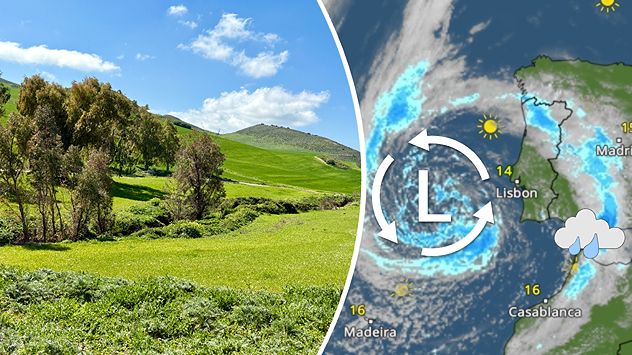
A green, rolling landscape after rain. Alongside it, a weather map showing a low-pressure system. Indications of further rainfall.
Wednesday, 8 April 2026

New low approaching

Morocco bursting to life after rain
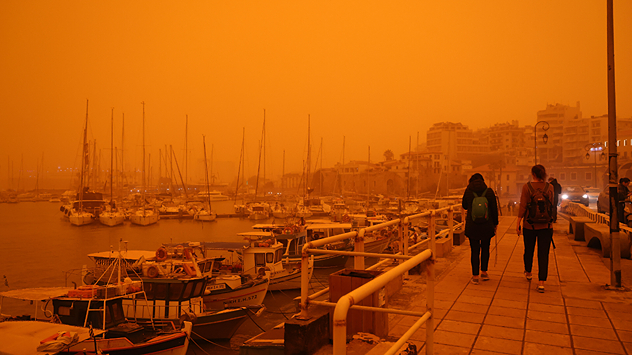
A harbour in Crete with a reddish-brown, overcast sky
Friday, 3 April 2026

Blood red skies

Dust storm in Crete
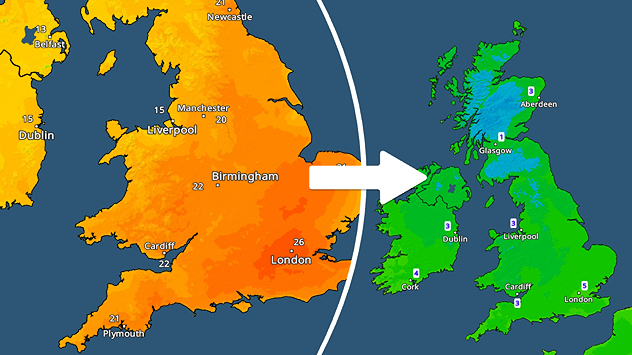
Split UK map showing warm orange temperatures up to 26 degrees on the left transitioning to cooler green tones around 3 to 5 degrees on the right, with an arrow indicating change.
Wednesday, 8 April 2026

A quick shift

High of the year to a cooler spell
All weather news
This might also interest you
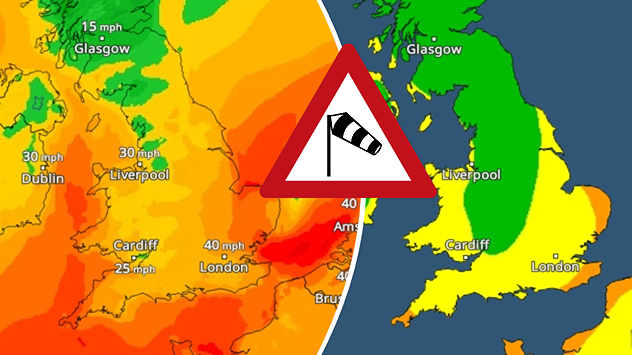
Split weather map showing UK wind speeds in orange-red shades up to 40 mph on the left and warning levels in green-yellow on the right, with a central wind warning sign.
Wednesday, 22 October 2025

Warnings active

Storm Benjamin impacts the UK
Split image showing a person in a yellow jacket struggling against strong winds and heavy rain on a street at night on the left, and an Irish wind forecast map on the right with red and purple shading, gusts up to 75 mph, and a wind warning icon, divided by a curved white line.
Saturday, 24 January 2026

On this day...

Historic Storm Éowyn arrives
Split image showing aerial flooding in a town with muddy water covering roads on the left, and a rural road on the right blocked by heavy snowfall with vans stopped and a person walking in snow.
Tuesday, 27 January 2026

Storm Chandra

Flooding, gales, and heavy snow
All articles
Weather & Radar

Weather & Radar is also available on

Google Play StoreApp Store

Company

Contact us Privacy Policy Legal info Accessibility statement

Services

Uploader

Socials

facebooktwittertikToklinkList