Home
Weather London
WeatherRadar
RainfallRadar
TemperatureRadar
WindRadar
LightningRadar
Weather News
Editor's Pick
Discover the app
Weather widget
Contact us
Apps
Career
Home / Editor's Pick /

October astronomy outlook: Two eclipses and two meteor showers!

15:00
1 October 2023

October astronomy outlook
Two eclipses and two meteor showers!

star-gazing

October brings a feast of astronomical events for stargazers, including two meteor showers and two eclipses... although these won't be too visible for those in the UK and Ireland.

The month is kicked off with the arrival of the Draconids meteor shower. Active from around October 6, and peaking the night of October 8. This is one of the slower showers of the year but is best seen in the early evening looking towards the Draco constellation.

On October 14 a new moon brings us an annular solar eclipse. This sees the moon entering the sun's path, but being too far away from Earth to completely block the light. Resulting in a halo appearing around the sun.

Sadly this will not be visible in the UK, Ireland, or Europe, but a new moon always brings darker skies ideal for spotting constellations, and possibly a few early Orionids.

Travelling during the eclipse?

The annular solar eclipse will be visible firstly off the coast of southern Canada before moving over southwestern America into Central America, reaching Columbia and Brazil before ending.

The second meteor shower of the month is also technically the first. Active from October 2, the Orionids reach their peak on the night of October 21, best seen between midnight and dawn. These meteors are parts of Halley's Comet, the comet itself will not return until 2061.

This shower originates from the Orion the Hunter constellation and runs until November 7.

October ends with the arrival of the Hunter's Moon on the 28th. Like all full moons, its name originates from Native American tribes. This year, the full moon also brings us a partial lunar eclipse.

The eclipse will be visible across Europe. Much of Asia and Africa will also see the event, while western regions of Australia and eastern parts of the US and southern America will see the eclipse as the moon rises.

If you're heading out for a night under the stars, don't forget your camera! We want to see your pictures! Use our uploader to submit, you don't need fancy equipment, even a smartphone can capture great shots.

Tips: Astrophotography with your phoneread more
Ryan Hathaway
More on the topic
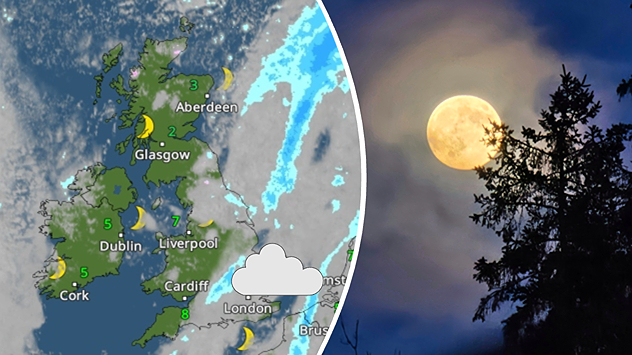
Split image with UK nighttime weather map on the left showing clouds, rain bands, and temperatures, and a bright full moon above dark pine trees on the right.
Wednesday, 1 April 2026

Good visibility for most

The Pink Moon rises tonight
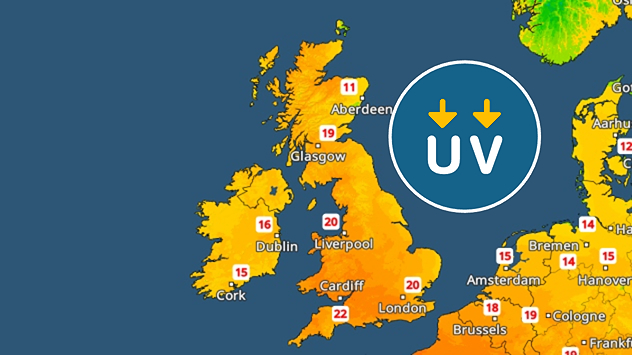
UK and Ireland map shaded in warm tones showing UV levels, with values up to 22 in southern England and lower values in Scotland, plus a circular UV icon.
Tuesday, 7 April 2026

Sunscreen season

UV levels rising with the warmth
Split image with Cromer Pier at sunset on the left in soft orange-blue tones and a moonlit Canterbury church with dramatic clouds on the right, lit by a streetlamp.
Sunday, 5 April 2026

Your weather - Your shots

Spring captured after the clock change
All weather news
This might also interest you
Illustration of white and yellow fireworks on a blue background.
Wednesday, 31 December 2025

Hello 2026

Happy New Year
Outline of Santa Claus with a yellow and white hat, "Ho-Ho-Ho" next to the outline above a Christmas tree.
Thursday, 25 December 2025

Merry Christmas!

Wishes from Weather & Radar
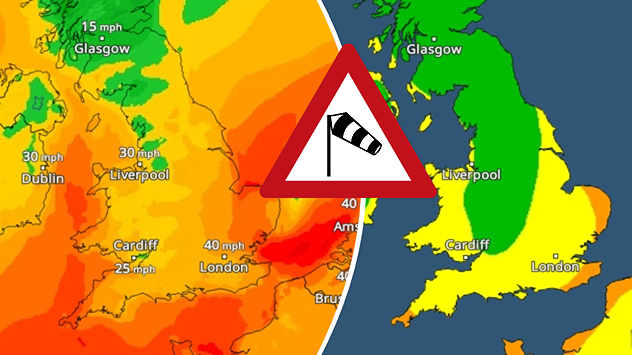
Split weather map showing UK wind speeds in orange-red shades up to 40 mph on the left and warning levels in green-yellow on the right, with a central wind warning sign.
Wednesday, 22 October 2025

Warnings active

Storm Benjamin impacts the UK
All articles
Weather & Radar

Weather & Radar is also available on

Google Play StoreApp Store

Company

Contact us Privacy Policy Legal info Accessibility statement

Services

Uploader

Socials

facebooktwittertikToklinkList