Home
Weather London
WeatherRadar
RainfallRadar
TemperatureRadar
WindRadar
LightningRadar
Weather News
Editor's Pick
Discover the app
Weather widget
Contact us
Apps
Career
    Home / Editor's Pick /

    Light display for Europe: Northern lights reach southern England

12:17
6 November 2023

Light display for Europe
Northern lights reach southern England

Settings for external content

Privacy Policy

The northern lights danced across the skies of the UK and Ireland, even reaching as far south as Cornwall.

Typically confined to more northern latitudes, the Aurora Borealis graced our skies in recent days.

Across the UK and Ireland during the early hours of Sunday November 5th, the aurora borealis graced our skies, much further south than is usual, reaching parts of southern England such as Cornwall and Wiltshire.

While cloud, mist and fog skewed the view for some, skies cleared to even allow the sight to be seen by the naked eye. More often that not, especially at our latitudes, the aurora is only visible through camera equipment attuned to capture the colours.

The Northern Lights can descend over England, Wales, and Ireland during times of increased solar activity, for example during geomagnetic storms.

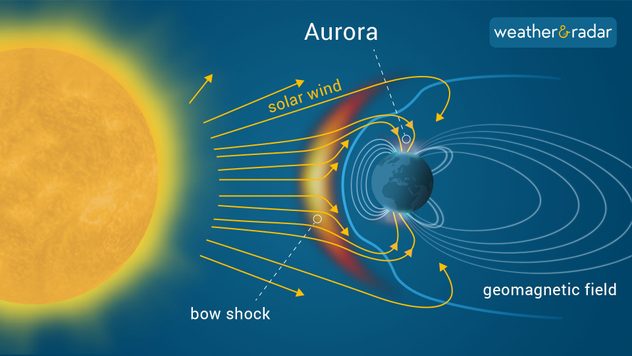
During these storms, the sun hires tremendous amounts of solar materials from coronal mass ejections or sunspots, which react with the magnetosphere. In this instance, a moderate G2 storm due to a coronal mass ejection was the cause.

As the solar wind approaches Earth, it encounters a shock wave known as a bow shock, where the wind interacts with our Earth's magnetic field.

Other parts of Northern, Central and Eastern Europe witnessed the spectacle too, including Germany, Romania, Slovakia, Hungary, Ukraine and even Bulgaria for the first time in history.

Ladakh, in the northern Indian subcontinent, also witnessed the aurora for the first time ever earlier this year. Scientists predict that sunspot observations will grow in the next 18 months to its highest in 20 years, with more areas perhaps able to witness the magic of the aurora.

Despite the strength of the geomagnetic storm, living in large cities can hamper your chance of spotting the spectacle due to light pollution masking the night sky. The weather can also make for difficult viewing conditions.

Auroras are also tricky to forecast, harder than our weather. The best way is to monitor the KP Index. This is a scale which tracks geomagnetic activity and runs from level zero to nine.

What causes the aurora?read more

For the lights to appear over England, a KP Index of five is generally required. Even then, we need clear, dark skies and a pinch of luck for one of nature's most awe-inspiring sights to appear.

Did you catch a glimpse? If you did, be sure to send in your shots for us to share via our uploader.

More on the topic
Damp Thursday as rain moves through. Raincoat needed. . . Thursday, 11 June 2026
Satellite weather map of the UK and Ireland on Thursday 11.06 showing a broad band of rain moving east-northeast across Britain, with a rain cloud icon, directional arrow, and temperatures around 11–15°C.
Thursday, 11 June 2026

Raincoat needed

Damp Thursday as rain moves through
Tropical storm hits Mexico. Ahead of the World Cup. . . Monday, 8 June 2026
A small weather map showing satellite imagery and precipitation over Europe. A red warning triangle with an exclamation mark is displayed in the bottom left-hand corner. The map shows numerous blue, yellow and orange weather symbols indicating active precipitation or areas of thunderstorms. The graphic conveys a general weather or severe weather warning.
Monday, 8 June 2026

Ahead of the World Cup

Tropical storm hits Mexico
The second warmest May on record. Early heatwave in Europe. . . Wednesday, 10 June 2026
Split image showing a European temperature anomaly map with widespread warmer-than-average conditions on the left and a poerson cooling off beside a fountain near the Eiffel Tower during hot weather on the right.
Wednesday, 10 June 2026

Early heatwave in Europe

The second warmest May on record
All weather news
This might also interest you
Storm Chandra makes impact. Severe gales & heavy rain. . . Tuesday, 27 January 2026
Split image showing strong winds over the UK on a forecast map and widespread rain and snow on a weather radar map.
Tuesday, 27 January 2026

Severe gales & heavy rain

Storm Chandra makes impact
Seasonal warmth between spring thunder. Your weather - Your shots. . . Sunday, 19 April 2026
Split image showing coastal sunset with layered lenticular clouds over rooftops and palm trees on the left, and a green valley with river and hills under soft daylight on the right.
Sunday, 19 April 2026

Your weather - Your shots

Seasonal warmth between spring thunder
Bright and warm conditions take hold. Spring-like outlook. . . Thursday, 23 April 2026
Split UK map showing warm temperatures up to 21 degrees in orange on the left and clear sunny conditions with temperatures from 12 to 18 degrees on the right, with sun icons across the country.
Thursday, 23 April 2026

Spring-like outlook

Bright and warm conditions take hold
All articles
Weather & Radar

Weather & Radar is also available on

Google Play StoreApp Store

Company

Contact us Privacy Policy Legal info Accessibility statement

Services

Uploader

Socials

facebooktwittertikToklinkList