Home
Weather London
WeatherRadar
RainfallRadar
TemperatureRadar
WindRadar
LightningRadar
Weather News
Editor's Pick
Discover the app
Weather widget
Contact us
Apps
Career
Home / Editor's Pick /

Light display for Europe: Northern lights reach southern England

12:17
6 November 2023

Light display for Europe
Northern lights reach southern England

Settings for external content

Privacy Policy

The northern lights danced across the skies of the UK and Ireland, even reaching as far south as Cornwall.

Typically confined to more northern latitudes, the Aurora Borealis graced our skies in recent days.

Across the UK and Ireland during the early hours of Sunday November 5th, the aurora borealis graced our skies, much further south than is usual, reaching parts of southern England such as Cornwall and Wiltshire.

While cloud, mist and fog skewed the view for some, skies cleared to even allow the sight to be seen by the naked eye. More often that not, especially at our latitudes, the aurora is only visible through camera equipment attuned to capture the colours.

The Northern Lights can descend over England, Wales, and Ireland during times of increased solar activity, for example during geomagnetic storms.

During these storms, the sun hires tremendous amounts of solar materials from coronal mass ejections or sunspots, which react with the magnetosphere. In this instance, a moderate G2 storm due to a coronal mass ejection was the cause.

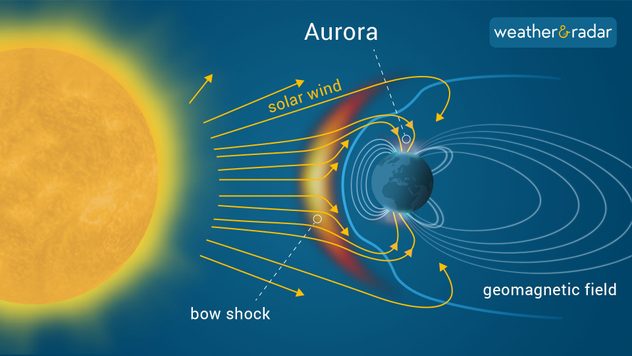
As the solar wind approaches Earth, it encounters a shock wave known as a bow shock, where the wind interacts with our Earth's magnetic field.As the solar wind approaches Earth, it encounters a shock wave known as a bow shock, where the wind interacts with our Earth's magnetic field.

Other parts of Northern, Central and Eastern Europe witnessed the spectacle too, including Germany, Romania, Slovakia, Hungary, Ukraine and even Bulgaria for the first time in history.

Ladakh, in the northern Indian subcontinent, also witnessed the aurora for the first time ever earlier this year. Scientists predict that sunspot observations will grow in the next 18 months to its highest in 20 years, with more areas perhaps able to witness the magic of the aurora.

Despite the strength of the geomagnetic storm, living in large cities can hamper your chance of spotting the spectacle due to light pollution masking the night sky. The weather can also make for difficult viewing conditions.

Auroras are also tricky to forecast, harder than our weather. The best way is to monitor the KP Index. This is a scale which tracks geomagnetic activity and runs from level zero to nine.

What causes the aurora?read more

For the lights to appear over England, a KP Index of five is generally required. Even then, we need clear, dark skies and a pinch of luck for one of nature's most awe-inspiring sights to appear.

Did you catch a glimpse? If you did, be sure to send in your shots for us to share via our uploader.

More on the topic
Split UK weather map showing widespread rain and cloud on the left, and clearer conditions on the right with sunshine in the west and moon icons indicating night in the south.
Friday, 17 April 2026

Rain clears the skies

Grey end to the week before clouds part
The map shows thunderstorm cells over southern Germany and northern Italy. On the right, hailstones lie on plants on the ground.
Tuesday, 21 April 2026

Large hailstones in Italy

A dramatic start to the thunderstorm season
Split image showing a coastal promenade with beach huts and lampposts under hazy daylight on the left, and a bright sunrise over a rocky shoreline with golden reflections on the water on the right.
Sunday, 26 April 2026

Your weather - Your shots

Sunny, settled conditions on camera
All weather news
This might also interest you
Outline of Santa Claus with a yellow and white hat, "Ho-Ho-Ho" next to the outline above a Christmas tree.
Thursday, 25 December 2025

Merry Christmas!

Wishes from Weather & Radar
Illustration of white and yellow fireworks on a blue background.
Wednesday, 31 December 2025

Hello 2026

Happy New Year
UK temperature map dated 14.02 showing widespread subzero values in blue shading, with readings such as −4 in Glasgow, −3 in Dublin, and −2 in London, alongside a blue thermometer icon.
Friday, 13 February 2026

Icy conditions

A frozen start to the weekend
All articles
Weather & Radar

Weather & Radar is also available on

Google Play StoreApp Store

Company

Contact us Privacy Policy Legal info Accessibility statement

Services

Uploader

Socials

facebooktwittertikToklinkList