Home
Weather London
WeatherRadar
RainfallRadar
TemperatureRadar
WindRadar
LightningRadar
Weather News
Editor's Pick
Discover the app
Weather widget
Contact us
Apps
Career
Home / Editor's Pick /

Latest solar activity: Large sunspot visible

06:00
24 January 2023

Latest solar activity
Large sunspot visible

A large sunspot is visible (right centre of image) on January 21st 2023.A large sunspot is visible (right centre of image) on January 21st 2023. - © NASA/SDO and the AIA, EVE, and HMI science teams

The sun is currently bubbling with activity, with one particularly large sunspot that is associated with strong solar flares.

Very large sunspots can currently be observed on the sun as dark spots, but you should never look straight at the sun without appropriate eye protection.

These dark spots are cooler and therefore emit less visible light than the rest of the surface. The largest spot in this group is about five times the diameter of the Earth and is clearly visible.

Effects of sunspots

The number and size of sunspots are an indication of the sun's activity, which follows a regular cycle. Around every 11 years, the activity oscillates between a fairly quiet phase and a period with significantly more plasma eruptions and strong solar winds.

The last sunspot minimum occurred in December 2019, with the next solar maximum expected around 2025, half a cycle (5.5 years) later.

We are currently in the middle of the 25th sunspot cycle (since 1755) so the current bubbling on the sun is nothing particularly unusual.

That being said, effects can still occur. The increased solar activity can cause so-called solar storms, where large quantities of charged particles are hurled into space, which often hit the Earth's magnetic field.

In particular instances, very strong solar storms can have serious consequences for the technical infrastructure:

  • Power grids collapse and GPS satellites fail.
  • Mobile phone networks are disrupted for months.
  • Blackouts are possible in conurbations, sometimes with losses running into billions.
  • Radar systems are disrupted and air traffic is affected.
  • Astronauts have to stay in their spaceships because of the strong radiation.
However these instances are rare and it is estimated that such strong solar storms only "hit" the Earth every 100 to 200 years. More often than not, there are no major problems on Earth and instead they produce beautiful auroras.

Weather & Radar editorial team
More on the topic
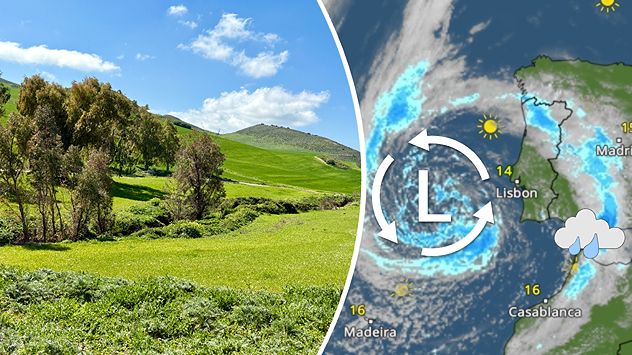
A green, rolling landscape after rain. Alongside it, a weather map showing a low-pressure system. Indications of further rainfall.
Wednesday, 8 April 2026

New low approaching

Morocco bursting to life after rain
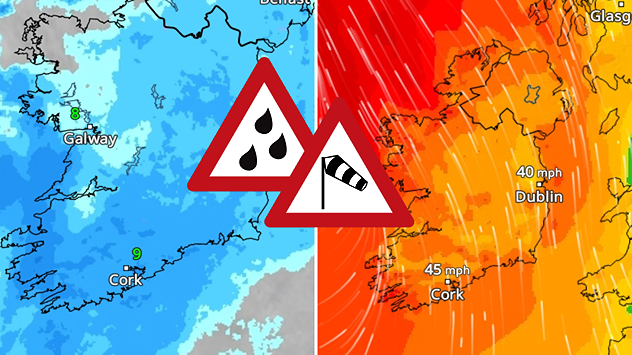
Split map of Ireland showing widespread rain in blue on the left and strong winds in orange on the right, with warning icons for heavy rain and gusty conditions up to 45 mph.
Thursday, 9 April 2026

Wet and windy for Ireland

Weather warnings as fresh low arrives
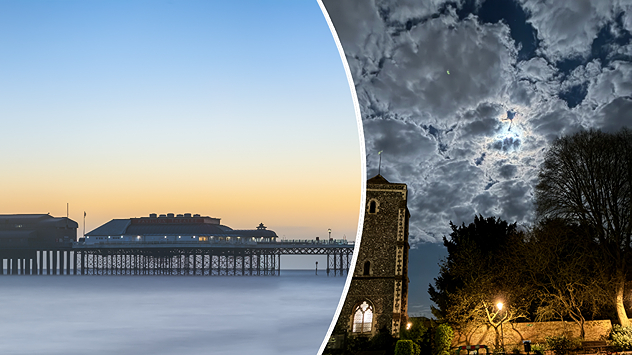
Split image with Cromer Pier at sunset on the left in soft orange-blue tones and a moonlit Canterbury church with dramatic clouds on the right, lit by a streetlamp.
Sunday, 5 April 2026

Your weather - Your shots

Spring captured after the clock change
All weather news
This might also interest you
Outline of Santa Claus with a yellow and white hat, "Ho-Ho-Ho" next to the outline above a Christmas tree.
Thursday, 25 December 2025

Merry Christmas!

Wishes from Weather & Radar
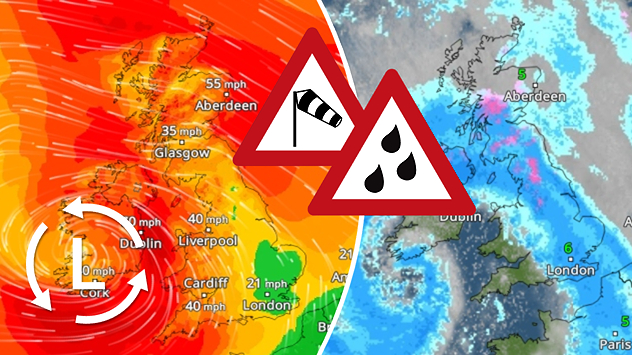
Split image showing strong winds over the UK on a forecast map and widespread rain and snow on a weather radar map.
Tuesday, 27 January 2026

Severe gales & heavy rain

Storm Chandra makes impact
Illustration of white and yellow fireworks on a blue background.
Wednesday, 31 December 2025

Hello 2026

Happy New Year
All articles
Weather & Radar

Weather & Radar is also available on

Google Play StoreApp Store

Company

Contact us Privacy Policy Legal info Accessibility statement

Services

Uploader

Socials

facebooktwittertikToklinkList