Home / Editor's Pick /

James Webb's first images: Unveiling the mysteries of the universe

14:00
16 April 2023

James Webb's first images
Unveiling the mysteries of the universe

Image of the assembly of the James Webb Telescope© NASA

Exploring the depths of our universe through the lens of the world's most powerful satellite.

NASA's James Webb Space Telescope was launched in 2021 and is the most powerful and complex telescope ever built.

Its advanced technologies and large mirror allow it to capture stunning images of the universe in infrared light, revealing important details about objects in space.

One of the key features of the telescope is its 6.5-metre diameter primary mirror, which is over 100 times larger than that of the Hubble Telescope. This allows it to capture more light and produce higher-resolution images.

The telescope also uses advanced technology to observe the universe in infrared light, which can reveal important details about objects that are hidden by dust clouds. Its complex system of mirrors and instruments works together to create high-quality images.

AstroGroup of galaxiesNebulaGalaxy group
1/4
“Cosmic Cliffs” in the Carina Nebula - © NASA

The James Webb Space Telescope is located at a point in space called the second Lagrange point, about 932,000 miles from Earth.

Where it will continue to capture stunning images of the universe that are impossible to see from Earth, making discoveries and taking space exploration to new heights.

Compared to weather satellites, which primarily focus on monitoring the Earth's weather patterns and climate, the James Webb Space Telescope is designed to observe deep space objects, including galaxies, stars, and exoplanets.

Its larger primary mirror allows it to capture more light and provide higher-resolution images of distant objects.

Additionally, being positioned in space at a much greater distance from Earth enables it to capture clearer images without atmospheric interference.

The James Webb Space Telescope is truly a marvel of modern technology, taking space exploration to new heights and making ground-breaking discoveries about the universe.

Weather & Radar editorial team
More on the topic
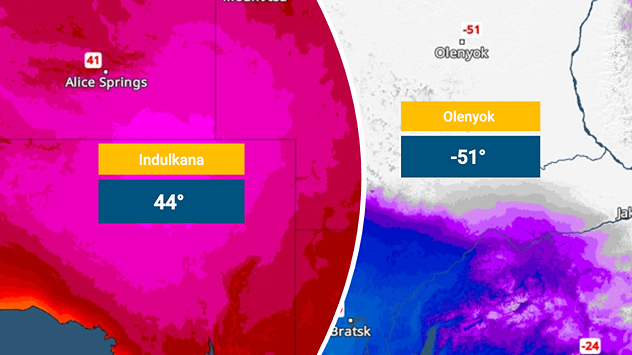
Map comparison showing 44 degrees in Indulkana and minus 51 degrees in Olenyok. Coloured temperature ranges show stark global contrasts.
Tuesday, 9 December 2025

Global extremes

Almost 100 degrees difference in temperature
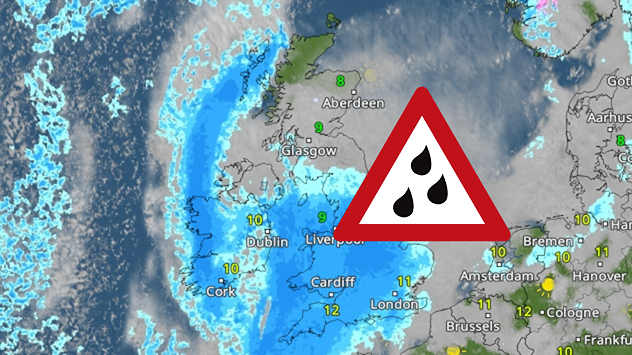
Radar map showing widespread blue rain bands over the UK and Ireland with a triangular heavy-rain warning icon placed over central Britain.
Tuesday, 16 December 2025

Thursday rain

Incoming downpour prompts warnings
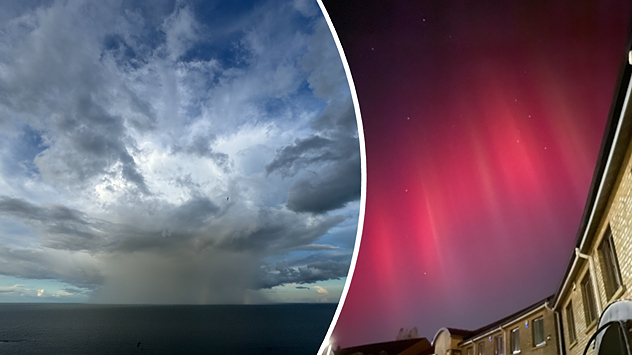
Split image showing a towering storm cloud with rain shafts over the sea on the left and a vivid red aurora illuminating the night sky above residential rooftops on the right, divided by a curved white line.
Tuesday, 9 December 2025

Your weather - Your shots

Autumn captured by you
All weather news
This might also interest you
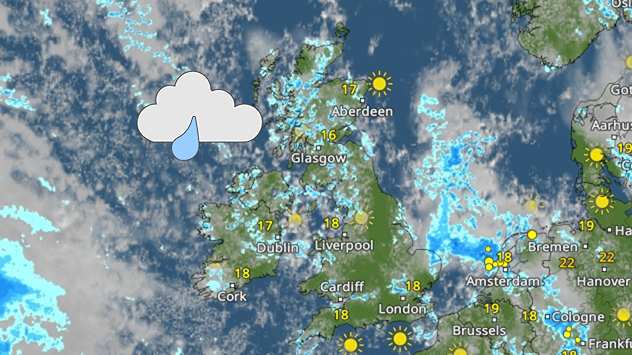
Weather map of the UK and Ireland showing scattered showers with cloudy patches across much of the region, especially around western and northern areas. Sunshine symbols appear over London, Cardiff, and parts of southern England, while temperatures range from 17°C to 18°C in most places. Areas of heavier rain are visible over the Atlantic to the west.
Friday, 29 August 2025

Breakfast brief

Unsettled conditions into the weekend
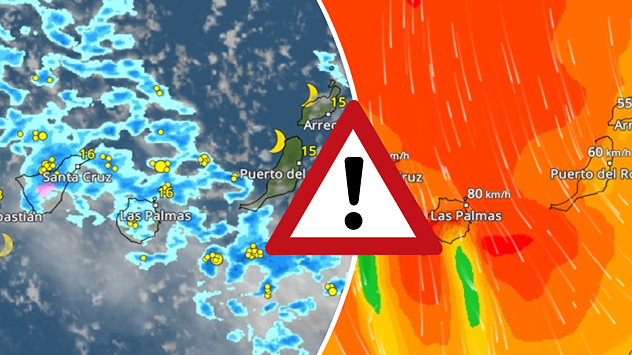
Weather graphic showing rain and wind fields over the Canary Islands and a central warning symbol.
Friday, 12 December 2025

Storm and rain

Turbulent weather in the Canary Islands
Monday, 25 August 2025

Bank holiday outlook

Warm day turning gusty in places
All articles
Weather & Radar

Weather & Radar is also available on

Google Play StoreApp Store

Company

Contact us Privacy Policy Legal info Accessibility statement

Services

Uploader

Socials

facebooktwittertikToklinkList