Home
Weather London
WeatherRadar
RainfallRadar
TemperatureRadar
WindRadar
LightningRadar
Weather News
Editor's Pick
Discover the app
Weather widget
Contact us
Apps
Career
Home / Editor's Pick /

Days are getting longer: Hours more daylight by end of the month

08:00
7 January 2024

Days are getting longer
Hours more daylight by end of the month

january

The dark days will soon be over. Throughout January, the daylight hours increase, though it is not uniform across all regions.

January typically stands as the coldest month of the year in the Northern Hemisphere. Following the winter solstice, the polar regions reach their maximum cooling, resulting in severe frosts on clear nights.

However, even as we patiently await the arrival of spring, the daylight hours are already on the rise.

This is most noticeable in the north of the country. In Inverness for example, December saw a minimum daylight length of 6 hours 35 minutes, while by the end of January, daylight will have extended to 8 hours 18 minutes; nearly a two hour difference.

Although these changes are initially slow in the mornings, the lengthening evening brightness becomes quite noticeable in the second half of the month. One contributing factor to this uneven increase in daylight is the orbital characteristics of the Earth's revolution around the sun.

Good observation nights for stargazers

Clear winter nights present excellent opportunities for stargazers in the UK and Ireland. Weather permitting, the extended winter nights showcase a plethora of captivating objects in the night sky.

Winter constellations, marked by their notably bright stars and numerous faint nebulae and galaxies, are easily visible, making a visit to an observatory highly rewarding.

Telescopes offer stunning views of many planets in our solar system. The dance of Jupiter's brightest moons around the giant planet is often more discernible on clear winter nights compared to the short and often hazy summer nights.

Additionally, the moon, with its changing phases, presents attractive views, especially at the boundary between the illuminated and shadowed sides.

Even with binoculars, the larger craters and the shadows cast by mountains on the moon's rugged surface are clearly visible.

For more information on the moon's phases in 2024 and special celestial alignments in the lunar calendar, we have all the details for you coming soon in the next astro outlook.

How to: Astrophotographyread more
Weather & Radar editorial team
More on the topic
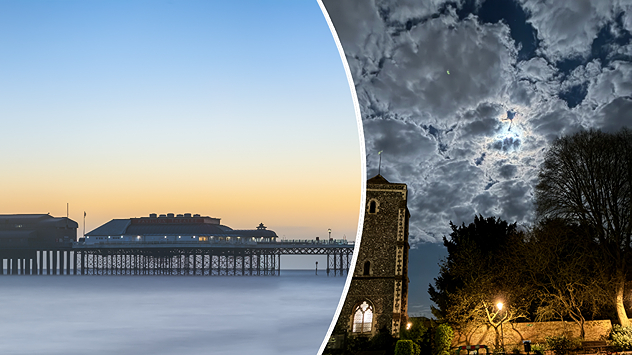
Split image with Cromer Pier at sunset on the left in soft orange-blue tones and a moonlit Canterbury church with dramatic clouds on the right, lit by a streetlamp.
Sunday, 5 April 2026

Your weather - Your shots

Spring captured after the clock change
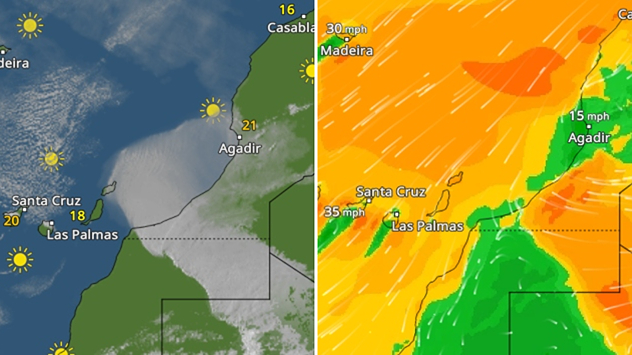
Left: Weather radar from Monday evening – Right: The corresponding wind radar
Wednesday, 1 April 2026

Air quality dropping

Saharan dust coats the Canaries
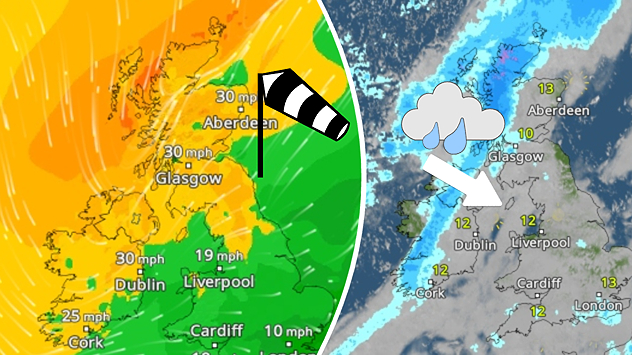
Split weather graphic showing breezy conditions across the UK and Ireland on the left with winds around 25–30 mph, and a rain band moving east across Ireland into Britain on the right.
Tuesday, 31 March 2026

Unsettled midweek

Wet & windy Wednesday for some
All weather news
This might also interest you
Illustration of white and yellow fireworks on a blue background.
Wednesday, 31 December 2025

Hello 2026

Happy New Year
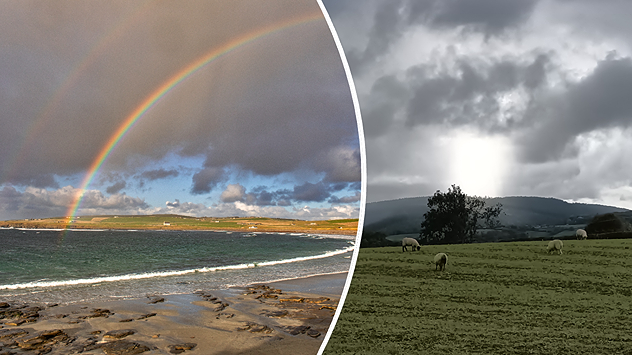
plit image showing a double rainbow over a rocky shoreline on the left and sheep grazing in a green field under stormy clouds on the right.
Sunday, 2 November 2025

Your weather - Your shots

Mixed conditions on an unsettled week
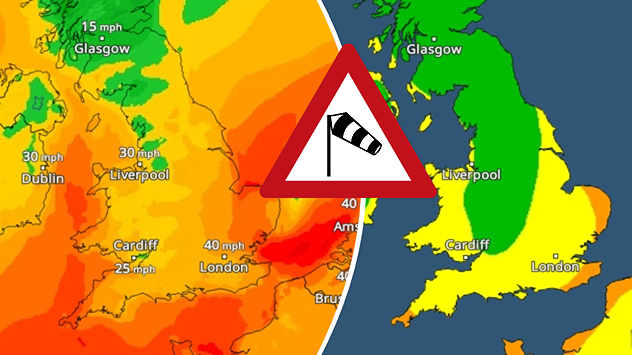
Split weather map showing UK wind speeds in orange-red shades up to 40 mph on the left and warning levels in green-yellow on the right, with a central wind warning sign.
Wednesday, 22 October 2025

Warnings active

Storm Benjamin impacts the UK
All articles
Weather & Radar

Weather & Radar is also available on

Google Play StoreApp Store

Company

Contact us Privacy Policy Legal info Accessibility statement

Services

Uploader

Socials

facebooktwittertikToklinkList