Home
Weather London
WeatherRadar
RainfallRadar
TemperatureRadar
WindRadar
LightningRadar
Weather News
Editor's Pick
Discover the app
Weather widget
Contact us
Apps
Career
Home / Editor's Pick /

British Science Week: How are weather forecasts created?

09:00
16 March 2023

British Science Week
How are weather forecasts created?

Rainy window with sun drawnWhether it's rain or sun, accurate weather forecasts are important in planning our day-to-day activates.

There is no better time to look deeper into meteorology than on British Science Week so today were letting you into the world of forecasts.

Meteorologists use some of the world’s most powerful super-computers to produce our weather forecasts.

These incorporate a vast amount of data and perform trillions of calculations per second to give us an idea of how the weather will change in the coming days.

Due to the complexity of the atmosphere however, even these weather forecasts tend to only be reliable for up to five days or so.

If the weather conditions are particularly complex, there can still be a degree of error even within the five-day period.

Any forecast that offers an outlook greater than ten days’ time is not considered a forecast but a trend.

To produce these forecasts, meteorologists usually run their forecast models a number of times and group the forecasts into what are known as clusters.

This gives probabilities of what may happen in the future, rather than one single solution.

Short-term forecasts cover a period of 24 hours up to three days. We see these on the TV every day. They are generated using synoptic meteorology – current atmospheric observations – and numerical models.

Medium-range forecasts cover between three and 10 days with long-term forecasts covering periods over 10 days away. Both are generated by using weather ensemble models to create a weather trend.

For both ranges, conditions tend to be described as wetter or drier, warmer or cooler with no specific information.

You can find all of this work in action each and every day with your local forecast in the app, and see it visualised via the WeatherRadar.

Ryan Hathaway
More on the topic
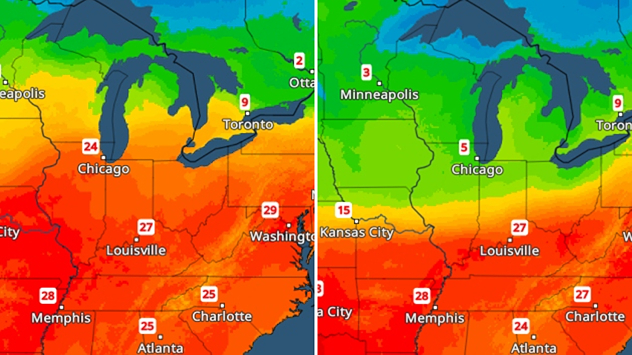
Two-part weather map of the USA: warm air with high temperatures on the left, significantly cooler on the right. The colours change from red/orange to green/blue, particularly in the North and the Midwest.
Tuesday, 31 March 2026

From 25, to 5 degrees

USA: Temperatures are up and down
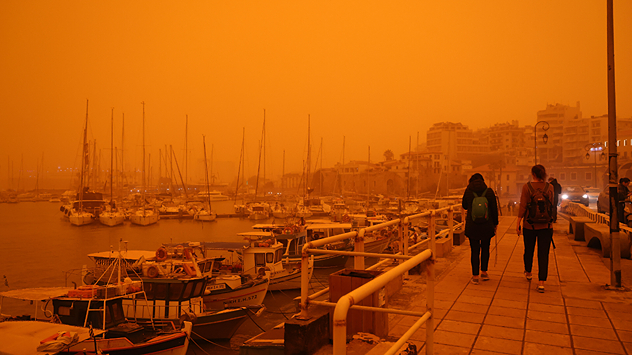
A harbour in Crete with a reddish-brown, overcast sky
Friday, 3 April 2026

Blood red skies

Dust storm in Crete
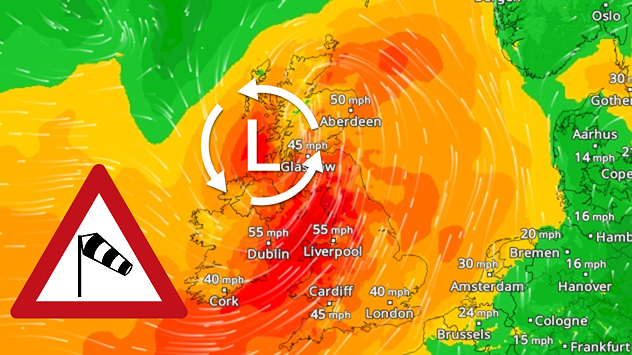
Wind map of the UK and Ireland showing a deep low-pressure system, Storm Dave, with red-orange zones and strong gusts up to 55 mph, plus a windsock warning icon indicating hazardous conditions.
Saturday, 4 April 2026

Severe overnight gales

Storm Dave makes impact
All weather news
This might also interest you
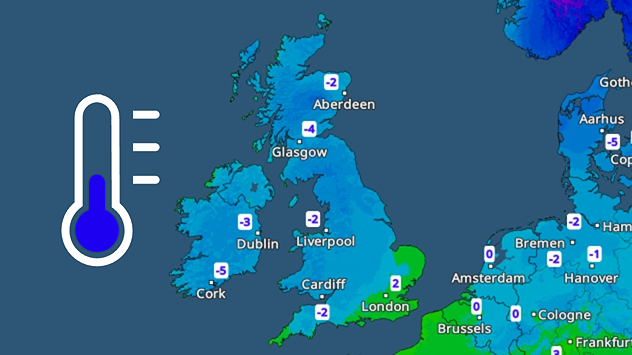
UK temperature map dated 14.02 showing widespread subzero values in blue shading, with readings such as −4 in Glasgow, −3 in Dublin, and −2 in London, alongside a blue thermometer icon.
Friday, 13 February 2026

Icy conditions

A frozen start to the weekend
Illustration of white and yellow fireworks on a blue background.
Wednesday, 31 December 2025

Hello 2026

Happy New Year
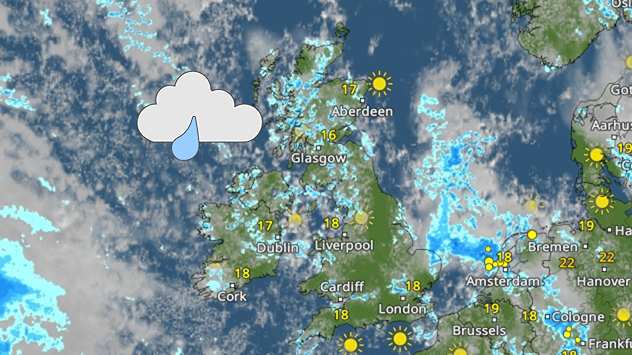
Weather map of the UK and Ireland showing scattered showers with cloudy patches across much of the region, especially around western and northern areas. Sunshine symbols appear over London, Cardiff, and parts of southern England, while temperatures range from 17°C to 18°C in most places. Areas of heavier rain are visible over the Atlantic to the west.
Friday, 29 August 2025

Breakfast brief

Unsettled conditions into the weekend
All articles
Weather & Radar

Weather & Radar is also available on

Google Play StoreApp Store

Company

Contact us Privacy Policy Legal info Accessibility statement

Services

Uploader

Socials

facebooktwittertikToklinkList