Home
Weather London
WeatherRadar
RainfallRadar
TemperatureRadar
WindRadar
LightningRadar
Weather News
Editor's Pick
Discover the app
Weather widget
Contact us
Apps
Career
Home / Editor's Pick /

Annual astro highlight: Perseid Meteor Shower to peak tonight

15:00
12 August 2023

Annual astro highlight
Perseid Meteor Shower to peak tonight

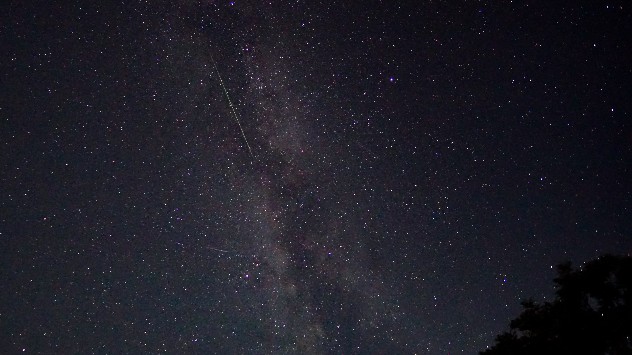
Shooting starA shooting star from the Perseids spotted in Harzgerode, Germany earlier this week. - © Torsten Brehme

One of the year's most active meteor showers is set to peak tonight, and with a new moon approaching soon, the night sky will be perfect for spotting shooting stars.

The Perseid Meteor Shower can produce up to 100 meteors an hour on particularly active years. We are set to see the peak overnight. While they will be visible from sunset, the best hours arrive between midnight and 05:30 am.

From the UK and Ireland, the radiant will appear from the Perseus constellation. After midnight, the Earth will have rotated to face the shower offering the most and brightest shooting stars.

Weather outlook

Saturday is marked by scattered showers and overcast conditions. By sunset, rain begins to clear in most areas, though some pockets remain by midnight with light clouds elsewhere.

By the early hours of Sunday morning the clearest skies can be found in southern Ireland, northeastern to central England, plus the far north and southwest of Scotland.

Tips for stargazing

For the best chance to see a meteor, find a dark area away from light pollution. Ideally in the countryside away from towns.

Specks of dust create the show

The nocturnal celestial spectacle is caused by the dust plume of the Comet Swift-Tuttle, which passes the earth every year in August.

When the dust particles, which are only millimetres in size, hit the upper layers of the Earth's atmosphere at a speed of 37 miles per second, they are abruptly slowed down and heated to white heat.

The particles then burn up in fractions of a second and paint their luminous trail on the night sky.

This constellation can be seen after dark in the northeast sky. The constellation Cassiopeia above Perseus helps with orientation. However, the shooting stars can also spread all over the sky.

Ryan Hathaway
More on the topic
Heavy snowfall has been bringing public life in Moscow to a standstill since Sunday evening.
Tuesday, 28 April 2026

Wind gusts, snow branches

Late April snow brings Moscow to a standstill
Split image showing a coastal promenade with beach huts and lampposts under hazy daylight on the left, and a bright sunrise over a rocky shoreline with golden reflections on the water on the right.
Sunday, 26 April 2026

Your weather - Your shots

Sunny, settled conditions on camera
Split image with a shooting star streaking across a starry night sky on the left and a UK nighttime weather map on the right showing cloud, clear spells, and temperatures.
Wednesday, 22 April 2026

Make a wish!

Lyrid meteor shower reaches its peak
All weather news
This might also interest you
Split UK map showing warm temperatures up to 21 degrees in orange on the left and clear sunny conditions with temperatures from 12 to 18 degrees on the right, with sun icons across the country.
Thursday, 23 April 2026

Spring-like outlook

Bright and warm conditions take hold
UK temperature map dated 14.02 showing widespread subzero values in blue shading, with readings such as −4 in Glasgow, −3 in Dublin, and −2 in London, alongside a blue thermometer icon.
Friday, 13 February 2026

Icy conditions

A frozen start to the weekend
Split image showing strong winds over the UK on a forecast map and widespread rain and snow on a weather radar map.
Tuesday, 27 January 2026

Severe gales & heavy rain

Storm Chandra makes impact
All articles
Weather & Radar

Weather & Radar is also available on

Google Play StoreApp Store

Company

Contact us Privacy Policy Legal info Accessibility statement

Services

Uploader

Socials

facebooktwittertikToklinkList