Home / Editor's Pick /

Weather explained: Why forecasting snow is so tricky

12:00
7 March 2023

Weather explained
Why forecasting snow is so tricky

Altitude-driven snow visible as a sharp dividing line in the Langdale Pikes, Lake District.Altitude-driven snow visible as a sharp dividing line in the Langdale Pikes, Lake District.

With snow on the cards during the autumn and winter season, you might be wondering how and why your forecast could change.

Snow forecasting can be particularly challenging due to its reliance on specific weather conditions. Often in northerly winds it can remain quite dry with just a wintry shower risk.

However, the presence of cold air combined with the movement of low-pressure systems, can often lead to more complex interactions between the warmer, moist air arriving, and the colder temperatures already in place.

The transition between rain and snow is often very subtle, so even if weather models or the WeatherRadar shows snow, it doesn’t always guarantee that snow will actually reach the ground.

Most precipitation first falls as snow from clouds, even sometimes in the summer months because it is so much colder higher up in the atmosphere.

Whether it then hits the ground as rain or snow depends on the temperature of the air that it’s falling through. The level at which the precipitation falls as rain rather than snow is known as the ‘freezing level’.

This is where the problems begin, because that can change over very short times and distances. When forecasting snow, elevation and surroundings are very important.

If the freezing level is higher than where you live but only by a fraction, you may be able to see snow on nearby hills. If you live in a city, it’s likely to be warmer than the countryside, so the snow could be just a few metres up the road.

The freezing level can change suddenly if the wind direction changes, altering where the air has come from or how long it has spent over the sea. If precipitation is falling heavily, it can drag down the freezing level down, turning heavy rain to snow.

If the temperatures are very low, then snow obviously becomes easier to predict. But in the UK and Ireland, our temperatures are often nearer freezing and a fraction of a degree is all that separates rain and snow.

Additionally, the track of a system can also affect where exactly it snows. With low pressure systems this week carrying milder air with them, a slight shift in the location of the system could alter the precipitation type.

This makes snow one of the most tricky parts of a forecast. Stay in the know on our WeatherRadar, so you can see the most up-to-date data yourself!

Weather & Radar editorial team
More on the topic
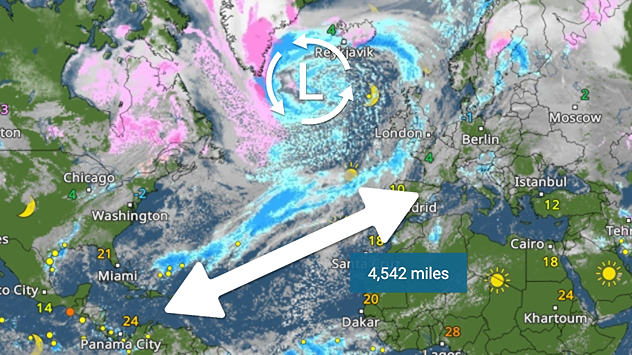
Weather map showing temperatures and a 4,542 mile route arrow over the Atlantic. Symbols indicate sun, clouds and precipitation from North America to Europe.
Wednesday, 17 December 2025

From Europe to America

Weather front over 4,500 miles long
Split image showing a towering storm cloud with rain shafts over the sea on the left and a vivid red aurora illuminating the night sky above residential rooftops on the right, divided by a curved white line.
Tuesday, 9 December 2025

Your weather - Your shots

Autumn captured by you
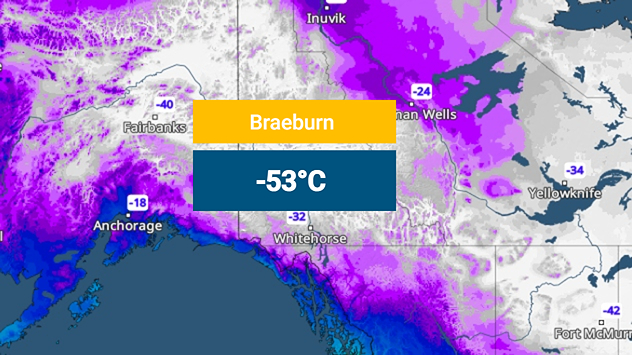
The weather map shows extremely low temperatures in Canada.
Monday, 15 December 2025

Minus 53 degrees

Record cold in Canada's Yukon Territory
All weather news
This might also interest you
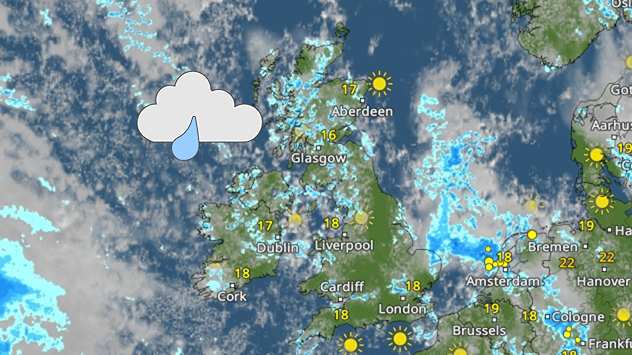
Weather map of the UK and Ireland showing scattered showers with cloudy patches across much of the region, especially around western and northern areas. Sunshine symbols appear over London, Cardiff, and parts of southern England, while temperatures range from 17°C to 18°C in most places. Areas of heavier rain are visible over the Atlantic to the west.
Friday, 29 August 2025

Breakfast brief

Unsettled conditions into the weekend
Friday, 22 August 2025

Breakfast brief

Sunny start for some, overcast later
Split weather map showing the UK and Ireland. The left side illustrates strong winds circulating around a low-pressure system, with gusts of 20–30 mph highlighted in orange and yellow. The right side shows radar imagery with widespread blue rain bands and patches of thunderstorms, especially over northern England and Scotland.
Thursday, 28 August 2025

Breakfast brief

Remaining widely unsettled
All articles
Weather & Radar

Weather & Radar is also available on

Google Play StoreApp Store

Company

Contact us Privacy Policy Legal info Accessibility statement

Services

Uploader

Socials

facebooktwittertikToklinkList