Home / Editor's Pick /

Twilight skies: What causes the explosion of colours?

16:00
28 January 2023

Twilight skies
What causes the explosion of colours?

twilight

As soon as the sun goes down, sunlight is by no means over. Twilight offers an explosion of colours in the sky for us to marvel at.

Twilight is the transitional period between day and night. In the evening it is called dusk, in the morning, dawn. Air molecules, aerosols and cloud droplets trigger the blaze of colour in the sky that often accompanies twilight.

How is twilight formed?

Tiny particles in the atmosphere are responsible for the colours lighting up the sky. When the sun is only slightly above the horizon, light takes a longer path through the atmosphere, than when the sun is higher up.

The influence of air molecules and aerosols, such as dust, increases the closer the sun is to the horizon. As shorter wavelengths (blue tones) are scattered more strongly, the sky turns a yellowish-red.

After sunset, the colours become even more intense because the low angle of the sun also illuminates the clouds.

Long after sunset, when the first stars twinkle, the sky turns deep blue. Although all the sun's rays have travelled a long way through the atmosphere, the blue colour components dominate once again.

This blue is a result of the stratospheric ozone layer at an altitude of 20 to 30 kilometres. Here, ozone molecules absorb the orange part of the light.

The selective absorption shifts the colours to the shorter wavelengths, i.e. to blue. When the sun is low, the ozone layer acts like a blue colour filter and we can see it with the naked eye.

Keep an eye out for our tips coming soon on how to photograph at twilight!

Weather & Radar editorial team
More on the topic
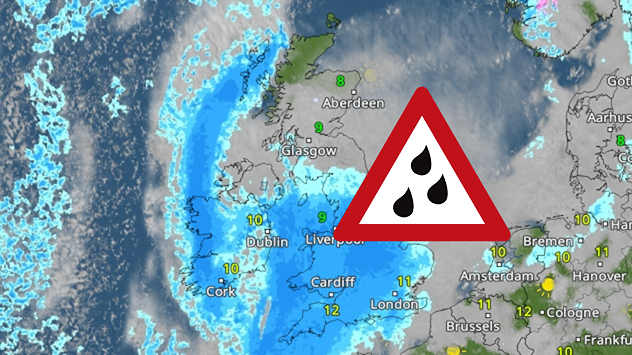
Radar map showing widespread blue rain bands over the UK and Ireland with a triangular heavy-rain warning icon placed over central Britain.
Tuesday, 16 December 2025

Thursday rain

Incoming downpour prompts warnings
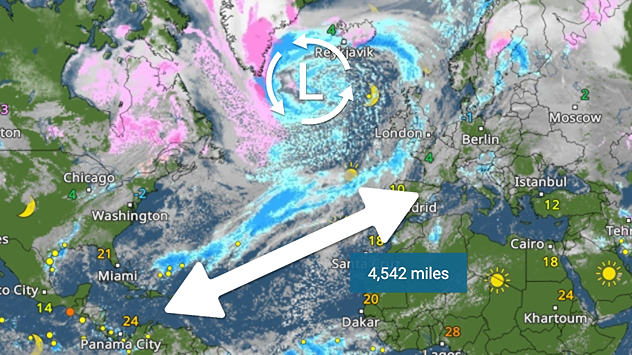
Weather map showing temperatures and a 4,542 mile route arrow over the Atlantic. Symbols indicate sun, clouds and precipitation from North America to Europe.
Wednesday, 17 December 2025

From Europe to America

Weather front over 4,500 miles long
Weather radar showing clouds and showers over Algeria and Morocco. Next to it, a warning map with the rain area in Algeria marked. Surrounding regions mostly sunny and dry.
Thursday, 18 December 2025

Algeria affected

Rain in the desert
All weather news
This might also interest you
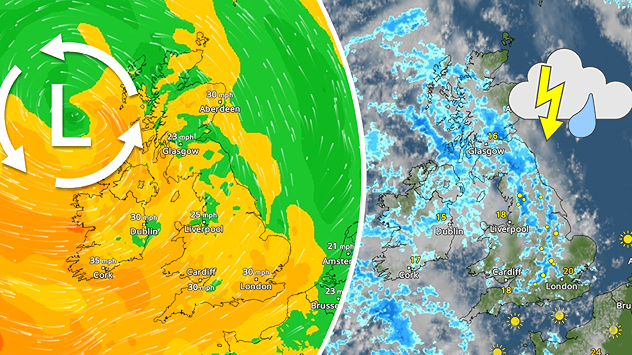
Split weather map showing the UK and Ireland. The left side illustrates strong winds circulating around a low-pressure system, with gusts of 20–30 mph highlighted in orange and yellow. The right side shows radar imagery with widespread blue rain bands and patches of thunderstorms, especially over northern England and Scotland.
Thursday, 28 August 2025

Breakfast brief

Remaining widely unsettled
Monday, 25 August 2025

Bank holiday outlook

Warm day turning gusty in places
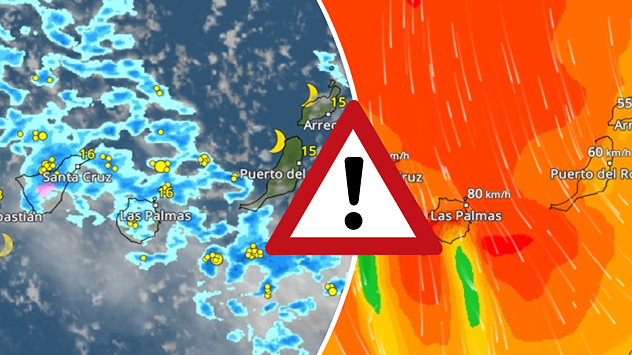
Weather graphic showing rain and wind fields over the Canary Islands and a central warning symbol.
Friday, 12 December 2025

Storm and rain

Turbulent weather in the Canary Islands
All articles
Weather & Radar

Weather & Radar is also available on

Google Play StoreApp Store

Company

Contact us Privacy Policy Legal info Accessibility statement

Services

Uploader

Socials

facebooktwittertikToklinkList