Home / Editor's Pick /

Temperature differences: Why is it warmer at the coast?

14:00
12 October 2022

Temperature differences
Why is it warmer at the coast?

england beach

As we head into autumn and winter, a notable temperature difference becomes apparent between inland and coastal areas, but why is that?

Through the spring and summer months, inland or land-locked areas are notoriously warmer than coastal areas, whilst during the autumn and winter, the opposite is true.

This is because of something called specific heat capacity, which is the amount of heat a material is capable of holding. Water has a higher specific heat capacity than land, which means that it can hold more heat.

Bodies of water take longer to heat up and cool down, so absorb all the heat through the spring and summer months, when the sun is at its strongest, and then lose that heat slower through autumn and winter, once it starts cooling down.

For land on the other hand, it heats up and cools down much quicker. So during the spring and summer months the ground quickly absorbs solar radiation, consequently also warming the layer of air above it. Whereas in winter, it quickly loses all of that heat back out to the atmosphere.

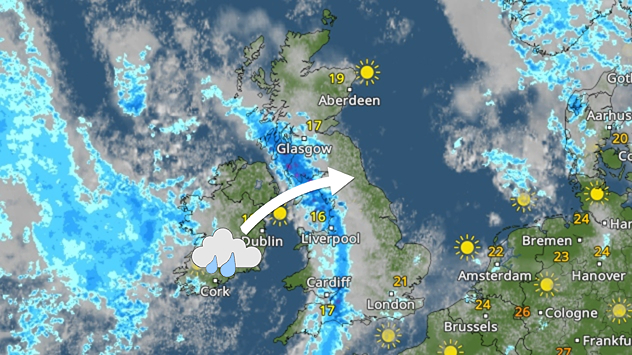
As a result, areas along the coast, or near large bodies of water, will retain that warmth thanks to the sea breeze effect. When air blows over land from the water, it warms those nearby areas, before the air then cools as it travels further inland.

Of course if the wind direction is off-shore then this is not the case however, but with our prevailing westerly winds, coastal parts of Wales and the west coasts of England, and also Ireland, will often remain a few degrees higher than areas further inland as we head into the colder months.

So, if you're looking for a less cold weekend staycation over the next few months, your best bet is to head there!

Weather & Radar editorial team
More on the topic
Shooting stars, part of the Geminid meteor shower.
Saturday, 13 December 2025

Spot a shooting star

King of meteor showers at its peak
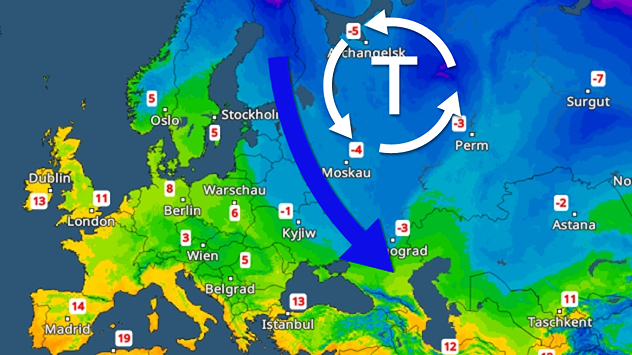
Map of Europe showing low pressure over Russia and a strong cold air flow towards Eastern Europe. Significant drop in temperatures across large parts of the east.
Thursday, 11 December 2025

Frost and snowfall

Cold air intrusion in Eastern Europe
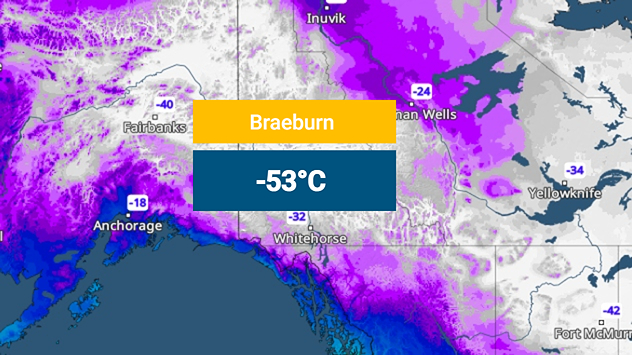
The weather map shows extremely low temperatures in Canada.
Monday, 15 December 2025

Minus 53 degrees

Record cold in Canada's Yukon Territory
All weather news
This might also interest you
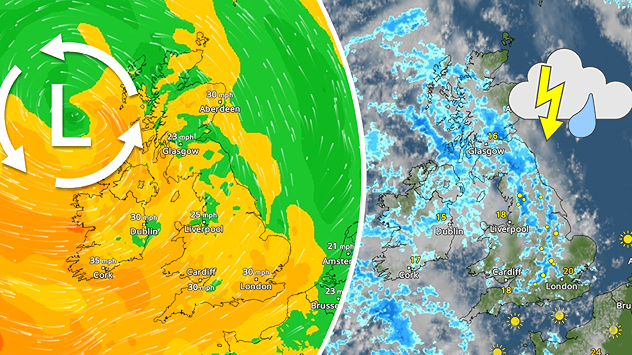
Split weather map showing the UK and Ireland. The left side illustrates strong winds circulating around a low-pressure system, with gusts of 20–30 mph highlighted in orange and yellow. The right side shows radar imagery with widespread blue rain bands and patches of thunderstorms, especially over northern England and Scotland.
Thursday, 28 August 2025

Breakfast brief

Remaining widely unsettled
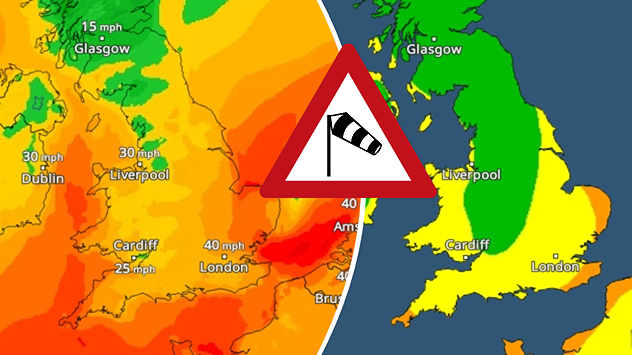
Split weather map showing UK wind speeds in orange-red shades up to 40 mph on the left and warning levels in green-yellow on the right, with a central wind warning sign.
Wednesday, 22 October 2025

Warnings active

Storm Benjamin impacts the UK
Wednesday, 27 August 2025

Breakfast brief

Frontal system brings heavy rain
All articles
Weather & Radar

Weather & Radar is also available on

Google Play StoreApp Store

Company

Contact us Privacy Policy Legal info Accessibility statement

Services

Uploader

Socials

facebooktwittertikToklinkList