Home / Editor's Pick /

Solar maximum approaches: Strongest solar flare since 2017

11:00
28 February 2024

Solar maximum approaches
Strongest solar flare since 2017

Solar flareThree X-class flares were recorded in a 24-hour period from February 22. - © NASA/SOHO

The peak of the Sun’s latest Solar Cycle is expected later this year, and a string of solar flares has highlighted the already rising intensity.

On February 22, three solar flares were recorded by the NOAA’s Space Weather Prediction Centre within 24 hours, with the third and final flare the strongest since 2017. This was an X6.3 flare, X-class flares denoting the most intense possible.

This emanated from a group of sunspots which has rotated across the solar disc into view from Earth. Increasing numbers of sunspots are common when the peak of a Solar Cycle is imminent.

Solar flares can disrupt communication systems on Earth, such as radio waves and sat-nav devices though no interruption was seen this weekend.

The peak of this Solar Cycle was initially expected in 2025, though last October the National Oceanic and Atmospheric Administration revised this to occur between January and October 2024.

Solar spectacle

The revised prediction means the maximum may now coincide with the total solar eclipse on April 8.

Each cycle is an 11-year period of activity on the Sun, as it reaches its peak activity such as solar flares grow more frequent.

These flares can hurl coronal mass ejections (CMEs) towards Earth, when the particles within a CME reaches the atmosphere it reacts to create auroras.

For anyone who has ever dreamed of seeing the Northern Lights, your chance to do so will rise significantly once the solar cycle maximum arrives.

Tips: Astrophotography with your phoneread more

Learn a little more about exactly what is involved with the creation of an aurora with our Weather Explained video:

Ryan Hathaway
More on the topic
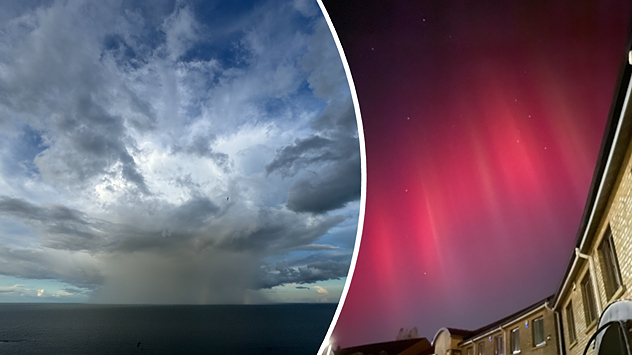
Split image showing a towering storm cloud with rain shafts over the sea on the left and a vivid red aurora illuminating the night sky above residential rooftops on the right, divided by a curved white line.
Tuesday, 9 December 2025

Your weather - Your shots

Autumn captured by you
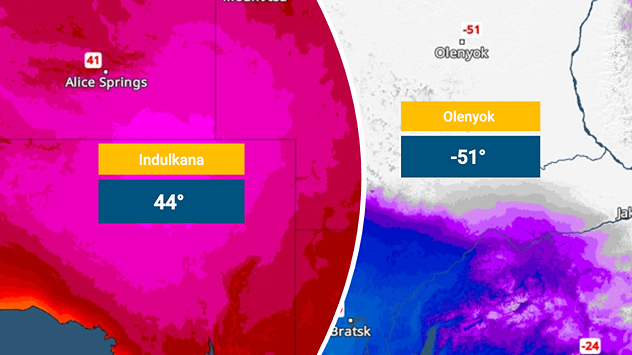
Map comparison showing 44 degrees in Indulkana and minus 51 degrees in Olenyok. Coloured temperature ranges show stark global contrasts.
Tuesday, 9 December 2025

Global extremes

Almost 100 degrees difference in temperature
pinecones
Thursday, 11 December 2025

Winter helpers

How pine cones aid the weather forecast
All weather news
This might also interest you
Friday, 22 August 2025

Breakfast brief

Sunny start for some, overcast later
Monday, 25 August 2025

Bank holiday outlook

Warm day turning gusty in places
Wednesday, 27 August 2025

Breakfast brief

Frontal system brings heavy rain
All articles
Weather & Radar

Weather & Radar is also available on

Google Play StoreApp Store

Company

Contact us Privacy Policy Legal info Accessibility statement

Services

Uploader

Socials

facebooktwittertikToklinkList