Home / Editor's Pick /

How do we find the UV-Index level?

15:00
8 July 2023

Forecasts explained
How do we find the UV-Index level?

Sunlight through trees

With the temperature on the rise this weekend, it's natural for us to check the UV-Index level and take precautions as needed. Do you know how it is calculated?

Some may think that it is possible to measure the amount of UV hitting the planet but it is actually more complicated than this.

In fact, the level is determined by a number of factors. This includes: atmospheric ozone levels, angle of sunlight, cloud cover, time of the year, and elevation.

The formula begins with the ozone layer. More dangerous shortwave UV is absorbed by the ozone layer so depending on how thick the layer is at any given time ground-level radiation may be stronger or weaker.

Multiple wavelengths are given a strength, from here a weighting factor is assigned using another calculation which determines the danger of each.

Three wavelengths will be measured, today we will use 280nm, 340nm, and 400nm. The strength is calculated from the ozone thickness and sunlight angle.

Once weighted we multiply the two. If the 280nm wavelength has a strength of 5 and a weight of 15 it would be 75.

This is done for all three wavelengths, the results are then added together to find a total UV effect, for now let’s say that this amounted to 280.

Now, we look at elevation and clouds. UV intensity rises by around 6% each kilometre above sea level and clouds absorb UV rays.

For this example, lets say we are at 1km elevation with 73% cloud cover. Now we multiple them all together, 280 x 1.06 x 0.73 which equals 216.7.

From here we divide by 25 and round to the nearest number. From our example the UV-Index level would be 9. So while it is easy to check the levels each morning, there is a lot of hard work that goes into finding that number!

Weather & Radar editorial team
More on the topic
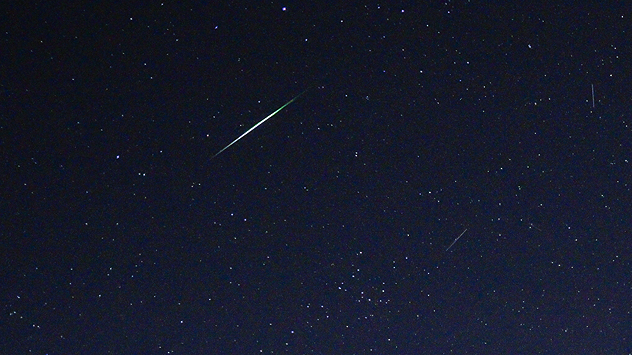
Shooting stars, part of the Geminid meteor shower.
Saturday, 13 December 2025

Spot a shooting star

King of meteor showers at its peak
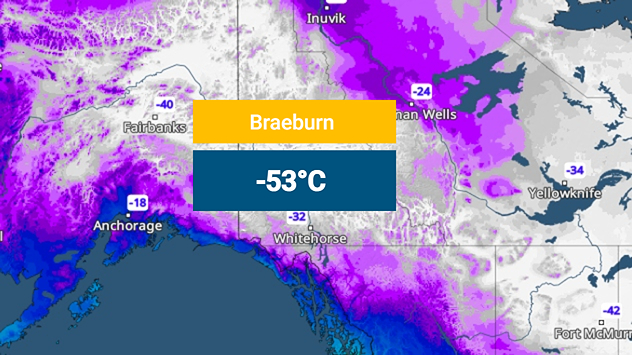
The weather map shows extremely low temperatures in Canada.
Monday, 15 December 2025

Minus 53 degrees

Record cold in Canada's Yukon Territory
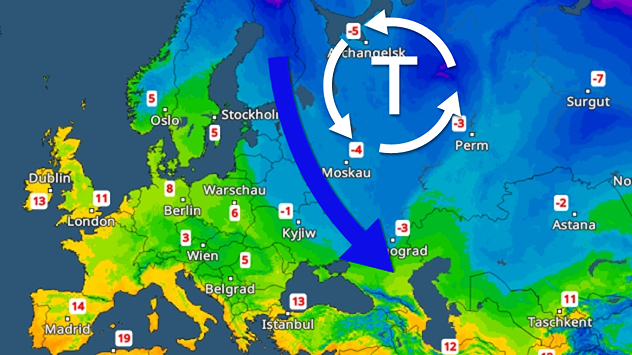
Map of Europe showing low pressure over Russia and a strong cold air flow towards Eastern Europe. Significant drop in temperatures across large parts of the east.
Thursday, 11 December 2025

Frost and snowfall

Cold air intrusion in Eastern Europe
All weather news
This might also interest you
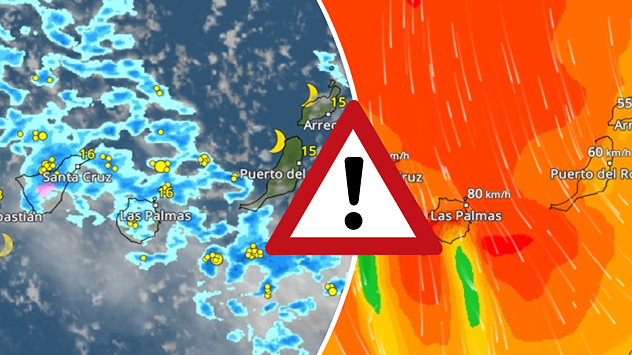
Weather graphic showing rain and wind fields over the Canary Islands and a central warning symbol.
Friday, 12 December 2025

Storm and rain

Turbulent weather in the Canary Islands
Friday, 22 August 2025

Breakfast brief

Sunny start for some, overcast later
Wednesday, 27 August 2025

Breakfast brief

Frontal system brings heavy rain
All articles
Weather & Radar

Weather & Radar is also available on

Google Play StoreApp Store

Company

Contact us Privacy Policy Legal info Accessibility statement

Services

Uploader

Socials

facebooktwittertikToklinkList