Home / Editor's Pick /

Flash of light from the depths of space

15:30
19 October 2022

Massive explosion
Flash of light from the depths of space

In early October, astronomers spotted the brightest gamma-ray burst ever. The flash of light came from a distance of almost 2 billion light years away and released massive amounts of energy.

It's thought that the origin of these gamma rays probably lies in the formation of a black hole. To put the power of the gamma burst in context, it released more energy in just a few seconds than our sun will release in its entire lifetime.

This phenomenon has been called the "event of the century" by astronomers. It is estimated that the cosmic flash of light originated at a distance of almost 2 billion light years, making it much closer to Earth than all other gamma-ray bursts.

632-illuArtistic representation of a gamma flash. - © ESO/L. Calçada / CC BY 4.0 CC BY

A light-year is a unit of length (like kilometres, for example) and is defined as the distance light travels in one year, the speed of which is 300 000 kilometres per second, rounded to the nearest kilometre.

There is still a lot to learn about gamma ray bursts. They are believed to form when massive stars explode at the end of their lives. This produces a very violent explosion called a supernova. The layers of the star are then scattered across the universe, leaving only its central core, which is so massive that it collapses into a rapidly spinning black hole.

Shock waves of gigantic jets

During this process, electromagnetic radiation is emitted in the form of very strongly bundled jets. These high-energy jets shoot through the supernova's gas, which spreads out almost as fast as light, and cause gigantic shock waves. It's these shock waves that cause the big flash of light.

This particular mega flash lasted several hundred seconds and is still continuing to glow in space. This afterglow can continue for several weeks, but can only be detected with particularly powerful telescopes.

No danger for Earth

Gamma ray bursts from beyond the solar system are generally considered to be harmless to us. The radiation they emit is simply too weak to trigger chemical reactions in the Earth's atmosphere.

If a closer band of jets were to hit the Earth precisely, a cosmic gamma-ray burst could damage the atmosphere and life on Earth. Fortunately, there are no signs of an imminent supernova in our solar system.

Weather & Radar editorial team
More on the topic
pinecones
Thursday, 11 December 2025

Winter helpers

How pine cones aid the weather forecast
Map comparison showing 44 degrees in Indulkana and minus 51 degrees in Olenyok. Coloured temperature ranges show stark global contrasts.
Tuesday, 9 December 2025

Global extremes

Almost 100 degrees difference in temperature
Shooting stars, part of the Geminid meteor shower.
Saturday, 13 December 2025

Spot a shooting star

King of meteor showers at its peak
All weather news
This might also interest you
plit image showing a double rainbow over a rocky shoreline on the left and sheep grazing in a green field under stormy clouds on the right.
Sunday, 2 November 2025

Your weather - Your shots

Mixed conditions on an unsettled week
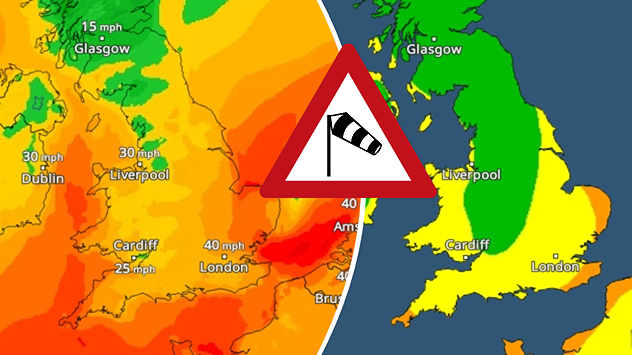
Split weather map showing UK wind speeds in orange-red shades up to 40 mph on the left and warning levels in green-yellow on the right, with a central wind warning sign.
Wednesday, 22 October 2025

Warnings active

Storm Benjamin impacts the UK
Friday, 22 August 2025

Breakfast brief

Sunny start for some, overcast later
All articles
Weather & Radar

Weather & Radar is also available on

Google Play StoreApp Store

Company

Contact us Privacy Policy Legal info Accessibility statement

Services

Uploader

Socials

facebooktwittertikToklinkList