Home / Editor's Pick /

Direct hit in space: DART probe crashes into asteroid moon

08:48
27 September 2022

Direct hit in space
DART probe crashes into asteroid moon

Recommended external content from YouTube

We need your consent to show content from YouTube. You can withdraw your consent at any time.

I agree that content from YouTube will be displayed to me.

Settings for external content

Privacy Policy
NASA's DART spacecraft has hit the asteroid moon Dimorphos as planned. Spectacular pictures and videos show the last moments before the direct hit in space.

The goal of NASA's DART (Double Asteroid Redirection Test) mission was to deflect the orbit of the 170m-wide asteroid moon Dimorphos.

To do this, a probe had to perfectly hit the celestial body, which is 11 million km away from Earth, on a precisely pre-calculated trajectory. Last night, the mission was crowned with a direct hit in space.

DimorphosThe image shows the asteroid moon Dimorphos immediately before the impact of the DART probe. - © NASA

This is the first time in human history that an attempt has been made to influence the trajectory of a celestial body. The asteroid did not and does not pose any danger to the Earth. The manoeuvre was merely a test for scientific purposes.

However, should an asteroid come dangerously close to Earth in the future, the findings of the DART mission could provide invaluable information for possible defence attempts.

According to estimates, there are more than 15,000 unknown asteroids crossing the Earth's orbit, which are large enough to destroy entire cities in the event of an impact.

The space probe was launched into space almost a year ago and hit the asteroid at 12.14am September 27th, BST. The spectacle was observed by the cameras of a small satellite that had previously been separated from the probe.

In addition, the James Webb and Hubble space telescopes as well as several telescopes on Earth followed the impact.

Dimorphos is the smaller body of the double asteroid Didymos. The impact of the space probe should reduce the speed of Dimorphos so that the asteroid orbits its "brother" in a smaller orbit in the future.

According to the scientists' calculations, this will shorten the orbital period of 12 hours by about 10 minutes.

Weather & Radar editorial team
More on the topic
Split image showing a towering storm cloud with rain shafts over the sea on the left and a vivid red aurora illuminating the night sky above residential rooftops on the right, divided by a curved white line.
Tuesday, 9 December 2025

Your weather - Your shots

Autumn captured by you
People walk through muddy streets after heavy rain, alongside a rain map of Morocco.
Tuesday, 16 December 2025

New rainfall in sight

Fatalities in Moroccan floods
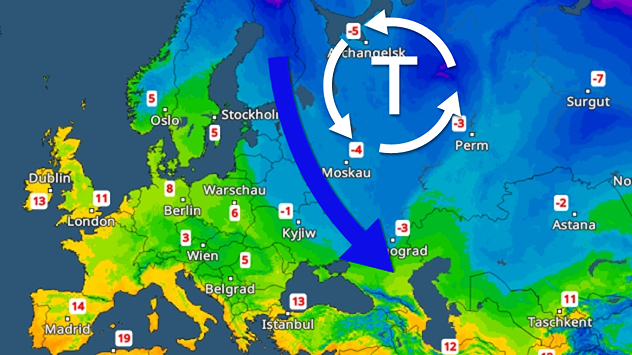
Map of Europe showing low pressure over Russia and a strong cold air flow towards Eastern Europe. Significant drop in temperatures across large parts of the east.
Thursday, 11 December 2025

Frost and snowfall

Cold air intrusion in Eastern Europe
All weather news
This might also interest you
Mammatus clouds
Thursday, 21 August 2025

Unusual view

Mammatus clouds over Ireland
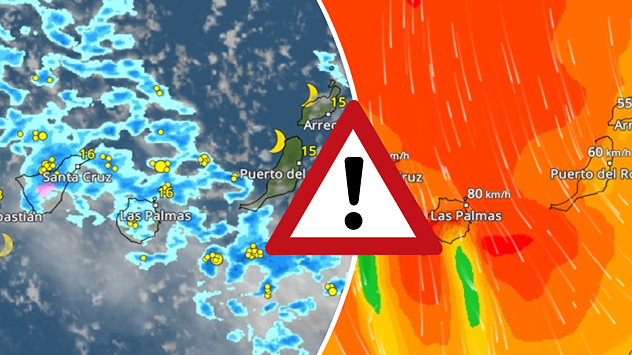
Weather graphic showing rain and wind fields over the Canary Islands and a central warning symbol.
Friday, 12 December 2025

Storm and rain

Turbulent weather in the Canary Islands
Monday, 25 August 2025

Bank holiday outlook

Warm day turning gusty in places
All articles
Weather & Radar

Weather & Radar is also available on

Google Play StoreApp Store

Company

Contact us Privacy Policy Legal info Accessibility statement

Services

Uploader

Socials

facebooktwittertikToklinkList